
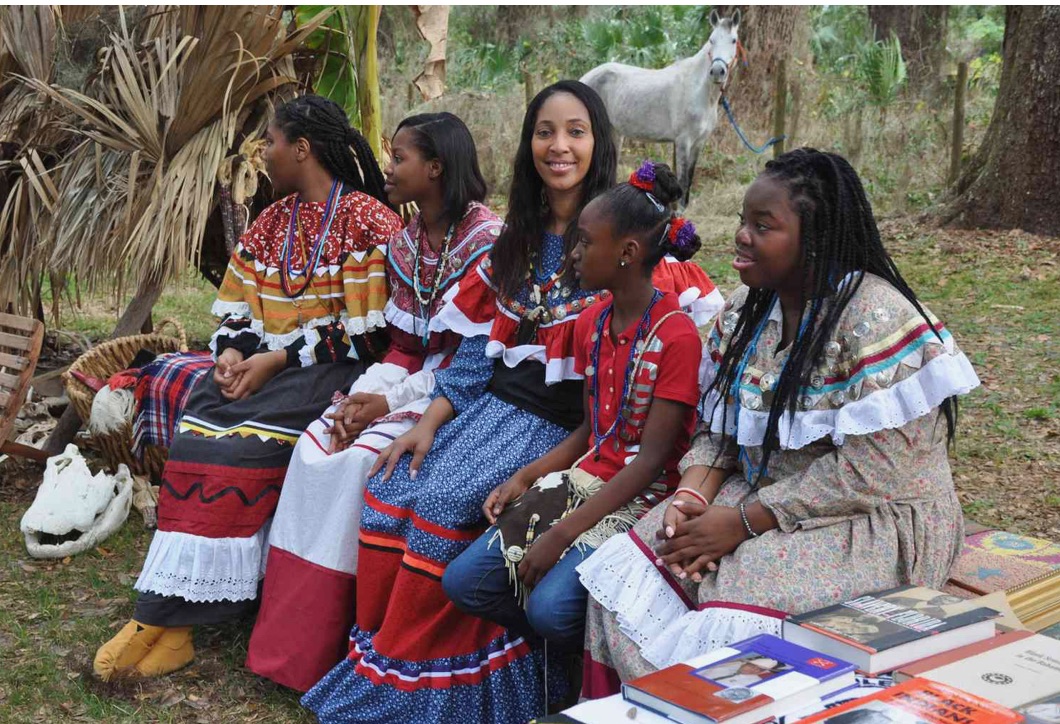
When discussing the Seminole people and their history, mainstream narratives often fail to acknowledge the deep connection between the Black Seminoles, the Indigenous Seminoles, and the broader history of Black Aboriginal Americans. These connections stretch back not only to pre-Columbian America but also to the Olmec and Mayan civilizations, offering a much richer and more complex story of identity, survival, and resistance.

Black Seminole Family SEMINOLES/GULLAH, Pinterest.com
The Seminoles: A Fusion of Indigenous and Black American Peoples
The Seminoles were originally a collection of Muskogee-speaking peoples who lived in the southeastern United States, particularly in Florida, Georgia, and Alabama. By the 18th century, their population was significantly influenced by Africans who had escaped enslavement in the British colonies. These escapees found sanctuary among the Seminoles and were absorbed into their communities, eventually forming what became known as the Black Seminoles.
Unlike the typical historical narrative that separates Indigenous and African peoples in America, the Seminole Nation stands as proof that these groups had long-standing alliances and shared ancestry. The Black Seminoles were not simply “runaway slaves”—many were descendants of the Black Aboriginal peoples of America who had been on the continent for thousands of years, tracing their lineage back to the mound-building civilizations and possibly even further to the Olmecs and Mayans.

OCLC 3529923
The Seminole Wars: Fighting Against Oppression
The Seminole Wars (1816-1858) were some of the most brutal and prolonged conflicts between Native American tribes and the U.S. government. They were largely fueled by the U.S. military’s desire to remove the Seminoles from Florida and expand slavery into new territories.
1. First Seminole War (1816-1819) – This war was largely a response to U.S. attempts to capture runaway Africans who had joined the Seminoles.
2. Second Seminole War (1835-1842) – The U.S. attempted to forcibly relocate the Seminoles to Indian Territory (Oklahoma). The Black Seminoles fought fiercely alongside their Indigenous counterparts.
3. Third Seminole War (1855-1858) – This was the final push to remove the last remaining Seminoles from Florida.
The Seminole resistance was legendary, and their ability to evade capture in the swamps of Florida made them one of the few Native nations to never formally surrender to the U.S. government.

The Trail of Tears and the Seminole Struggle
The Trail of Tears is often associated with the forced relocation of the Cherokee, Creek, and Choctaw peoples, but the Seminoles also endured this forced march. After years of warfare, many Seminoles and Black Seminoles were forcibly removed from Florida and sent to Indian Territory (modern-day Oklahoma).
• Thousands died along the journey from disease, starvation, and exhaustion.
• The Black Seminoles faced an even harsher fate, as many were enslaved or captured by white settlers and rival Native nations.
• A small group of Seminoles refused to leave Florida, retreating deep into the Everglades, where their descendants still reside today.
The forced removals were not just about land—they were about erasing a powerful Black and Indigenous identity that had resisted colonial rule for centuries.
The Black Seminoles and the Aboriginal American Identity
The history of the Black Seminoles aligns with Livity.blog’s mission of reclaiming Black Aboriginal identity. The Black Indigenous presence in the Americas predates Columbus and colonial conquest. The Olmecs, the first known civilization in Mesoamerica, left behind massive stone heads with African features, linking them to the Black presence in the Americas long before European contact.
Connections to the Olmecs and Mayans
• The Olmecs (1500 BCE–400 BCE) were the earliest civilization in Mesoamerica and are widely believed to have influenced the later Mayan civilization.
• Both the Olmecs and Mayans shared architectural, spiritual, and cosmological traditions that align with those found in North American mound-building cultures (like the Washitaw and the Mississippians).
• Many Black Indigenous groups, including the Black Seminoles, carry oral histories that speak of their ancient connection to Mesoamerica and the Caribbean.
• The Muskogee-speaking tribes (which the Seminoles were a part of) share linguistic and cultural similarities with Mesoamerican civilizations, suggesting a migration or trade network long before European colonization.
The Black Seminoles, much like the Olmecs and Mayans, represent a continuation of an ancient lineage that was forcibly rewritten by colonial history.
The Legacy of the Seminole Resistance
The Seminoles’ story is a testament to resilience. Their fight against U.S. expansion was not just about land—it was about freedom, identity, and survival. Today, their legacy remains a powerful symbol for Black Aboriginal identity in the Americas.
• The Black Seminole diaspora is still found in the U.S., the Caribbean, and even Mexico, where some fled to escape re-enslavement.
• The Seminoles who remained in Florida continue to honor their heritage and warrior spirit.
• Their history is a reminder that the division between Black and Native identities was imposed by colonial forces, not an inherent truth.
The Seminole story is our story—a story of Aboriginal survival, resistance, and truth. Their legacy, much like that of the Olmecs and Mayans, calls for us to reclaim and restore our rightful place in history.
Livity.blog: Restoring the Aboriginal Connection
At Livity.blog, we are dedicated to unveiling these hidden histories—to showing that Black people in America are not just descendants of enslaved Africans but also the original Indigenous inhabitants. The Black Seminoles stand as living proof of this truth.
It is time to reclaim the legacy that was erased. Join us on Livity.blog to rediscover the wisdom of Aboriginal heritage, unveil hidden histories, and empower Indigenous futures. Together, let’s honor the past to inspire a brighter tomorrow.
🌿 Rooted in ancestral truth, unveiling hidden legacies, and nurturing the spirit of Indigenous resilience.
References
1. Florida Department of State. “Black Seminoles.” Florida Memory. https://www.floridamemory.com
2. Porter, Kenneth W. The Black Seminoles: History of a Freedom-Seeking People. University Press of Florida, 1996.
3. Zinn Education Project. “Second Seminole War Begins.” Zinn Project, 2023. https://www.zinnedproject.org/news/tdih/second-seminole-war/
4. Littlefield, Daniel F. Africans and Seminoles: From Removal to Emancipation. Greenwood Press, 1977.
5. Wright, J. Leitch. Creeks and Seminoles: The Destruction and Regeneration of the Muscogulge People. University of Nebraska Press, 1986.
6. Gibson, Arrell M. The American Indian: Prehistory to the Present. D.C. Heath, 1980.
7. Wikipedia Contributors. “Black Seminoles.” Wikipedia, The Free Encyclopedia, 2024. https://en.wikipedia.org/wiki/Black_Seminoles
8. Texas State Historical Association. “Black Seminole Indians.” Handbook of Texas Online. https://www.tshaonline.org/handbook/entries/black-seminole-indians
9. Smithsonian Institution. “The Trail of Tears and the Forced Relocation of the Seminoles.” Smithsonian National Museum of the American Indian, 2022. https://americanindian.si.edu
10. Diehl, Richard A. The Olmecs: America’s First Civilization. Thames & Hudson, 2004.
11. Van Sertima, Ivan. They Came Before Columbus: The African Presence in Ancient America. Random House, 1976.
12. Wikipedia Contributors. “Olmec Alternative Origin Speculations.” Wikipedia, The Free Encyclopedia, 2024. https://en.wikipedia.org/wiki/Olmec_alternative_origin_speculations
