
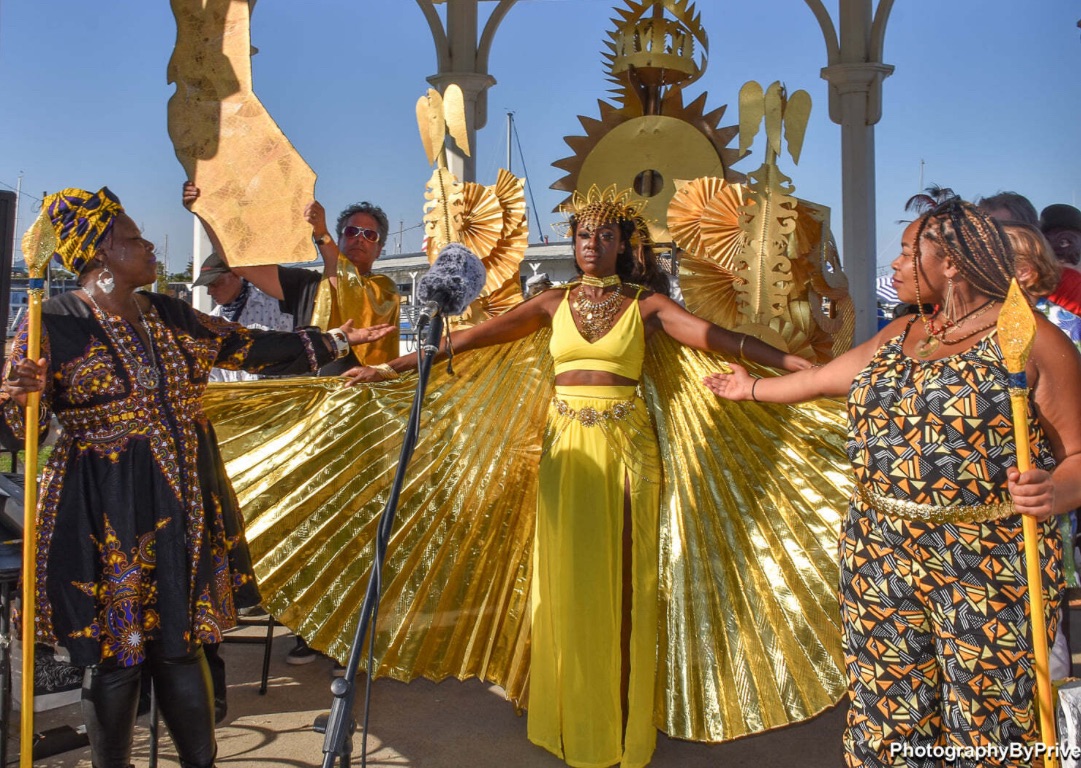
Theory: Queen Calafia and the Amazonian Tribe of Ancient California – A Land Shaped by Water and Legend
The legend of Queen Calafia, the powerful Black Amazon warrior queen, may not be entirely myth. What if her story is a remnant of a real matriarchal warrior society that once thrived in what we now call California? When we examine both historical records and geological findings, a compelling theory emerges—one that suggests that at the time of early exploration, California may have been partially isolated by vast bodies of water, reinforcing the belief that it was an island.
A Land Once Surrounded by Water
Ancient California looked vastly different from today. The remnants of prehistoric lakes and changing sea levels may explain why early cartographers repeatedly depicted California as an island:
• Lake Corcoran (aka Lake Clyde) once covered the entire Central Valley, creating a massive inland sea that drained into the Pacific Ocean through present-day San Francisco Bay.
• After the drainage of Lake Corcoran, parts of California—including the Baja Peninsula region and the Los Angeles Basin—still had large water bodies covering vast areas.
• The shifting water levels and remaining lakes could have easily made California appear detached from the mainland when viewed from the south by early explorers.
Thus, 16th-century Spanish explorers could have easily mistaken California for an island, especially if they approached from the Gulf of California, seeing only the Baja Peninsula and surrounding waters.

The Warrior Women of California
The myth of Queen Calafia was first recorded in Las Sergas de Esplandián (1510), but where did this idea originate? Could it have been inspired by real encounters with warrior tribes in the region?
Evidence suggests that pre-Columbian Indigenous cultures had societies that honored warrior women, spiritual leaders, and matriarchal traditions:
• The Chumash and Tongva peoples of Southern California had female chiefs and were known for their advanced maritime culture, which could have influenced European stories of an island nation.
• Amazonian-like warrior cultures existed in other parts of the Americas, particularly among Indigenous groups in South America and the Caribbean.
• Early Spanish and Indigenous oral histories describe warrior women in the Baja Peninsula and the Gulf of California, leading some researchers to believe there may have been matriarchal or warrior-led tribes in pre-contact California.
If a matriarchal warrior society once ruled parts of the Baja Peninsula and the surrounding lands, their dominance in the region could have influenced the legend of Queen Calafia and her army of Black Amazons.
Cartographers and the “Island” of California
The idea of California being an island persisted in European maps for nearly 200 years. Even after explorers like Father Eusebio Kino proved otherwise in the late 1600s, maps continued to show California as separate from the mainland.
Why?
• From the south, explorers approaching via the Gulf of California would have seen a vast waterway where Lake Corcoran once was.
• The Baja Peninsula, which extends nearly 800 miles into the Pacific, may have reinforced the illusion that California was cut off from the mainland.
• Rising and falling sea levels over thousands of years could have left temporary or seasonal flooding that made the land appear even more isolated.
This geographic confusion, paired with stories of powerful warrior women living in the region, could have fueled the myth of Queen Calafia’s kingdom—a lush, gold-filled island ruled by Black Amazons.
The Legend and the Lost Reality
While no direct evidence proves Queen Calafia’s existence, the combination of historical accounts, Indigenous oral traditions, and geological evidence paints a fascinating picture. It is possible that:
• A real matriarchal warrior society existed in ancient California, possibly centered in Baja California or the Central Valley before Lake Corcoran drained.
• Spanish explorers, encountering this culture, misunderstood or exaggerated their findings, linking them to the legend of the Amazons.
• Cartographers, relying on limited exploration and old maps, reinforced the idea of California as an island because the landscape still had major water bodies separating it from the mainland.
Thus, Queen Calafia’s legend may be the last surviving memory of a real, forgotten civilization—one that thrived in a time when California was still shaped by ancient waters.
🔥 Could Queen Calafia have been real? Could her people have ruled a lost California that early explorers mistook for an island? Let’s discuss! Drop your thoughts in the comments.
🌿 Follow @Livity.Blog for more hidden histories, Indigenous resilience, and cultural storytelling.
🌿 Rooted in ancestral truth, unveiling hidden legacies, and nurturing the spirit of Indigenous resilience.
#QueenCalafia #LostHistory #IslandOfCalifornia #AncientWarriorWomen #MatriarchalSocieties #BajaCalifornia #IndigenousHistory #HiddenTruths #AncestralWisdom #LivityBlog
References & Sources:
1. Lake Corcoran and Ancient California’s Flooded Valleys
• Wikipedia. Lake Corcoran. https://en.wikipedia.org/wiki/Lake_Corcoran
• California Sun. The Central Valley Was Once a Watery Landscape. https://www.californiasun.co/californias-central-valley-was-once-a-watery-landscape-of-lakes-and-marshes-then-we-sucked-it-dry/
2. Queen Calafia and the Legend of the Island of California
• KQED. Our Origin Story: Queen Calafia Returns to California in a New Theatre Production. https://www.kqed.org/news/11892023/our-origin-story-queen-calafia-returns-to-california-in-new-theatre-production
• Atlas Obscura. California’s Name Comes From a 16th Century Black Warrior Queen. https://www.atlasobscura.com/articles/california-etymology-black-queen
• Wikipedia. Calafia. https://en.wikipedia.org/wiki/Calafia
3. The Island of California – A Cartographic Mystery
• Stanford University. California as an Island: A Geographical Misconception. https://exhibits.stanford.edu/california-as-an-island
• National Geographic. Why 17th-Century Maps Show California as an Island. https://www.nationalgeographic.com/culture/article/why-17th-century-maps-show-california-as-an-island
4. Indigenous Warrior Women and Matriarchal Societies in the Americas
• Indigenous America. Matriarchal Societies in Pre-Colonial America. https://indigenous-america.org/matriarchal-societies-precolonial
• American Archaeology. Were There Amazon Warrior Women in North America?
