

Reclaiming Lost Narratives
When most people think of St. Patrick’s Day, they envision parades, green beer, and celebrations of Irish heritage. But beneath the surface of this widely recognized holiday lies a deeper, more complex history—one that connects Ireland’s ancient past to a global narrative of lost civilizations and forgotten migrations.
There is a prevailing myth that civilizations developed in isolation—that the great megalithic structures of Ireland, Africa, the Americas, and beyond were built independently, with no cross-cultural exchange. Yet, a growing body of alternative historical research suggests that early Black civilizations—particularly the Twa people—may have left their mark on prehistoric Ireland.
Could there have been early migrations from Africa to Europe long before recorded history? Could the builders of Ireland’s megalithic tombs and stone circles have shared a lineage with the ancient peoples of Africa? These are the questions that challenge the conventional timeline of human migration—and invite us to rethink what we know about Ireland’s ancient origins.

Who Are the Twa? The First People of the Earth
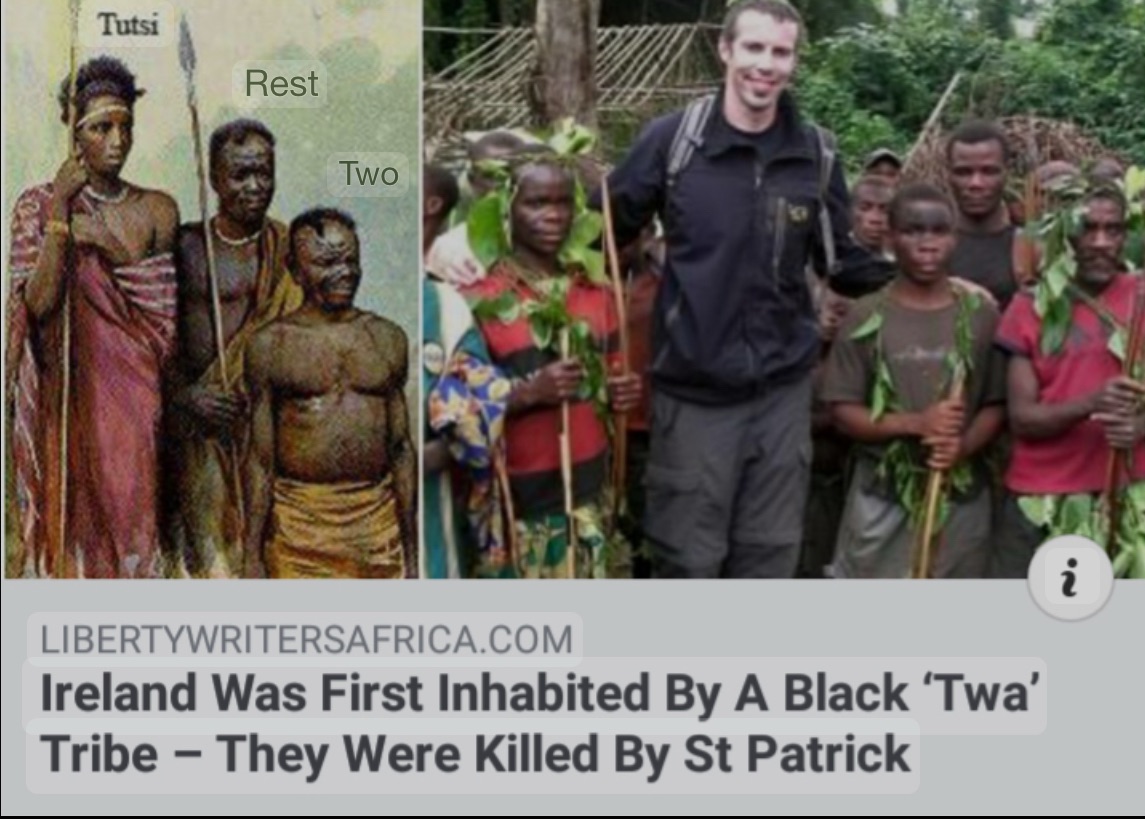
The Twa people, often referred to as the Batwa, are among the oldest known human populations on the planet. Found primarily in Central Africa, the Twa are a hunter-gatherer society with deep-rooted traditions that date back tens of thousands of years. Genetic studies have shown that their lineage is one of the most ancient, diverging from other human populations before recorded history even began.
🌍 Why does this matter?
If the Twa represent the earliest human ancestry, then the possibility of their migration to Europe in prehistoric times is not far-fetched. After all, early African migrations have shaped civilizations across the globe. From the Black Aboriginal Australians to the Olmecs in Mesoamerica, ancient Black populations have been at the forefront of some of the world’s oldest cultures.
Could they have reached Ireland before the arrival of Celtic tribes?
This is where things get interesting.

The Mysterious Megalithic Monuments of Ireland
Ireland is home to some of the oldest and most sophisticated megalithic structures in the world, many of which predate even the Egyptian pyramids. Some of the most famous include:
🔺 Newgrange – A 5,200-year-old passage tomb aligned perfectly with the Winter Solstice sun, suggesting an advanced knowledge of astronomy.
🔺 The Hill of Tara – A sacred ceremonial site that was home to the ancient Irish High Kings.
🔺 Carrowmore Megalithic Complex – One of the largest megalithic grave sites in Europe, built with precise engineering and spiritual alignment.
These massive stone circles, tombs, and monuments resemble structures found across Africa, particularly in Sudan, Ethiopia, and even West Africa. The similarities have led some scholars to ask:
📜 Could an ancient African group—possibly the Twa—have influenced the builders of Ireland’s megalithic sites?
Ancient Migrations: Could the Twa Have Reached Ireland?
🌊 One of the most challenging aspects of rewriting history is overcoming the idea that early civilizations were isolated.
Conventional historians argue that Ireland’s first inhabitants arrived from mainland Europe following the last Ice Age, yet alternative researchers suggest an earlier African presence.
Some of the supporting theories include:
✅ Prehistoric African Seafarers – The presence of early African navigators is well-documented. Ancient Egyptians and West Africans are believed to have reached the Americas before Columbus. Could similar seafarers have traveled to Ireland, guided by the stars?
✅ Shared Symbolism & Architecture – The megalithic tombs of Ireland bear striking resemblances to stone circles and sacred enclosures found in Africa. Some indigenous Irish myths speak of “dark-skinned builders” and “ancient ones” who arrived before the Celts.
✅ The “Little People” Myth – Irish folklore often references the Tuatha Dé Danann and other “small, dark-skinned” supernatural beings with great wisdom and knowledge of the land. Could these legends be distorted memories of early Black Indigenous peoples?
This theory is not without controversy, and mainstream archaeologists argue that the timelines do not align. However, new genetic research continues to challenge the long-held belief that Europe was entirely homogenous before recorded history.
Pangea & The Global Connection of Early Peoples
There’s another way to look at this: prehistory doesn’t begin with written records—it begins with the land itself.
🌍 If we go back far enough in Earth’s history, we find that continents were once connected.
Many researchers exploring deep-time migration patterns believe that early Black populations—including the Twa and the Aboriginal Australians—may have migrated far beyond Africa due to land bridges, changing climates, and ancient seafaring.
Similar theories have been proposed about the Australian Aboriginals—one of the oldest known civilizations in the world—who some believe may have reached the Americas long before the first “official” migrations.
So, if Pangea once allowed people to move across what we now call Europe, Africa, and the Americas, why wouldn’t early Black civilizations have left their imprint on Ireland, Scotland, and the British Isles?
Why This Matters Today
🎭 St. Patrick’s Day is often celebrated without understanding the deeper histories of Ireland’s past.
🌿 What if Ireland’s history is older, more diverse, and more interconnected with the African world than we’ve been led to believe?
🔥 The forced erasure of Black contributions to history is nothing new. From the Washitaw Mounds of North America to the Olmec heads of Mexico, evidence of ancient Black civilizations has often been ignored or rewritten.
The Twa and their possible presence in Ireland challenge the Western historical narrative—forcing us to ask:
📜 How much of the truth has been buried?
📜 What other global connections have we yet to uncover?
📜 And why does this history remain hidden?
Final Thoughts: Reclaiming the Truth
History is not a single story—it is a tapestry woven from many threads, some of which have been deliberately unraveled.
Whether or not the Twa or another ancient African group reached Ireland, their existence forces us to rethink human migration, shared knowledge, and the true scope of early Black civilizations.
This is about more than just alternative history—it’s about reclaiming our past, our connections, and our rightful place in the human story.
📢 What do you think? Could the Twa have reached Ireland? Drop a 🍀 in the comments if you believe history has been rewritten!
🌿 Follow @livity.blog333 on instagram for more hidden histories and ancestral wisdom.
✨ Rooted in Ancestral Truth. Unveiling Hidden Legacies. Nurturing the Spirit of Indigenous Resilience.
#HiddenHistory #TwaPeople #StPatricksDay #AncientIreland #MegalithicMysteries #LivityBlog #WeAreTheAncestors #BlackIndigenousHistory
References:
1. The Twa People:
• “Twa.” Wikipedia, en.wikipedia.org/wiki/Twa.
• “African Pygmies May Be Older Than Thought.” Science News, 9 Apr. 2009, http://www.sciencenews.org/article/african-pygmies-may-be-older-thought.
2. Ireland’s Megalithic Structures:
• “Megalith.” Wikipedia, en.wikipedia.org/wiki/Megalith.
• “The Tracing of the Shrew: Why Celtic DNA Leads Back to Africa.” The Irish Times, 23 Apr. 2012, http://www.irishtimes.com/news/environment/the-tracing-of-the-shrew-why-celtic-dna-leads-back-to-africa-1.522345.
3. Alternative Theories and Connections:
• “Africa & Ancient Ireland: Africa to Iberia.” Modern Ghana, 15 Feb. 2018, http://www.modernghana.com/news/829972/africa-ancient-ireland-africa-to-iberia.html.
• “The Omission of an Ancient African Irish Population from Contemporary Western Education.” Academia.edu, http://www.academia.edu/104886320/The_Omission_of_an_Ancient_African_Irish_Population_from_Contemporary_Western_Education.
4. Ancient Migrations:
• “The Evolutionary History of Human Populations in Europe.” PubMed, 2018, pubmed.ncbi.nlm.nih.gov/29960127/.
• “Out of Africa: How Early Humans First Got to Europe.” CBS News, 14 July 2013, http://www.cbsnews.com/news/what-route-did-early-humans-take-out-of-africa/.
5. Genetic Studies:
• “Genetic History of West Africa.” Wikipedia, en.wikipedia.org/wiki/Genetic_history_of_West_Africa.
• “Native American Populations Descend from Three Key Migrations.” UCL News, 12 July 2012, http://www.ucl.ac.uk/news/2012/jul/native-american-populations-descend-three-key-migrations.
6. Cultural Connections:
• “Africa and ‘Blackness’ in the Irish Imagination.” Moore Institute, 26 June 2020, mooreinstitute.ie/2020/06/26/africa-and-blackness-in-the-irish-imagination/.
• “On the Link Between African and Irish Music.” Infinite Culture, 31 Jan. 2011, infiniteculture.wordpress.com/2011/01/31/on-the-link-between-african-and-irish-music/.
