
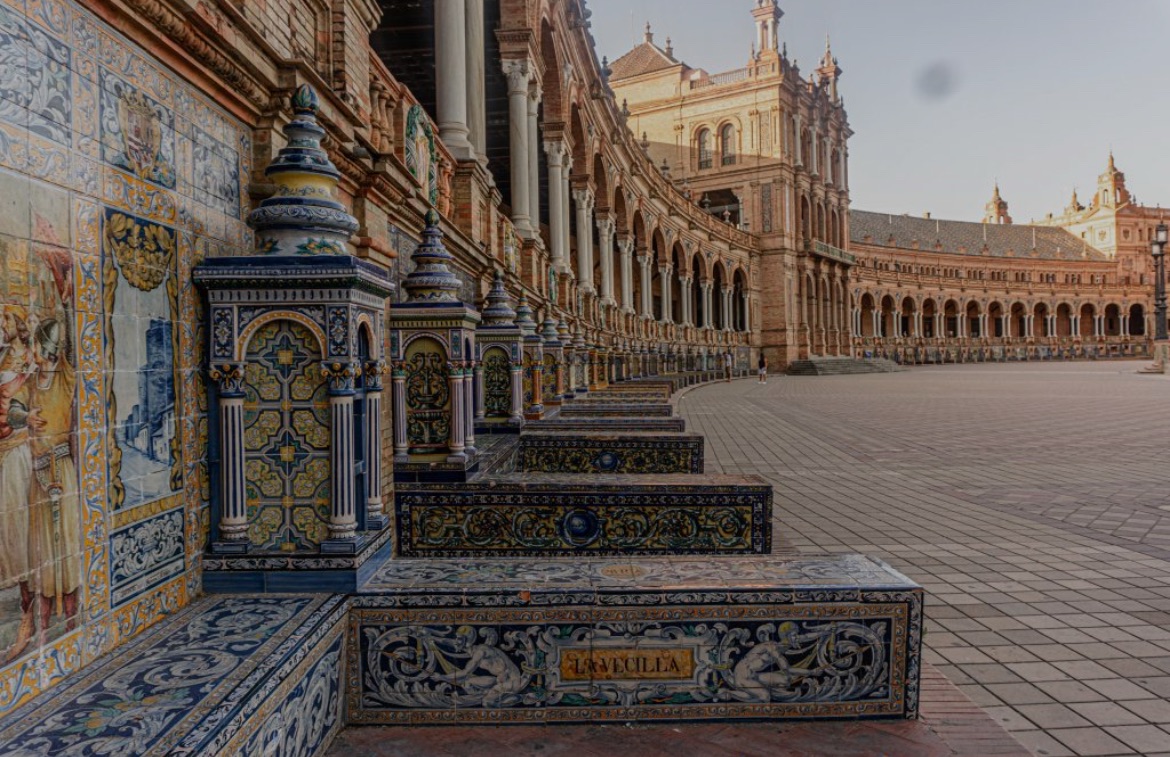
Exploring the Hidden History and Moorish Architecture That Still Shapes Europe
“They called it Al-Andalus. We call it memory. A place where African minds, Islamic vision, and Indigenous spirit reshaped the very foundation of Europe.”
Introduction: A Forgotten Golden Age
When people visit southern Spain, they marvel at the ornate palaces, flowing fountains, intricate tilework, and geometric mosques-turned-cathedrals.
But most don’t realize they’re walking through African-Islamic architecture — built by Black and Arab Moors, scientists, builders, and mystics who transformed Europe from the shadows of the so-called Dark Ages into a beacon of light.
This was Andalusia — once called Al-Andalus — a region ruled by the Moors for nearly 800 years.
Their influence still echoes through architecture, philosophy, science, and language — though much of it has been erased from public memory.

Who Were the Moors?
The Moors were Black and Arab Muslims from North and West Africa, many of whom came from Berber, Mandinka, Hausa, and Fulani cultures, as well as Arabized Africans.
In 711 CE, led by Tariq ibn Ziyad (a general of Amazigh and likely Sub-Saharan descent), the Moors crossed the Strait of Gibraltar — which they named after him (Jabal Tariq — “Tariq’s Mountain”) — and quickly established rule over much of the Iberian Peninsula.
Their reign, especially in Andalusia, brought:
Multilingual education Public libraries Engineering feats like aqueducts and irrigation Advances in medicine, astronomy, math, architecture, and art Cultural fusion with Sephardic Jews, Christians, and other ethnic groups
This was not merely conquest — it was civilization expansion through culture, intellect, and spiritual design.

Moorish Architecture: Sacred and Geometry & Symmetry
The Moors built with intention.
They used geometry as prayer, symmetry as reflection, and water as a sacred connector to the Divine.
Their buildings still stand today across Andalusia, including in:
Granada – The Alhambra (a palace and fortress complex of incredible mathematical design) Cordoba – The Mezquita-Catedral (once a mosque, still holding its Islamic arches and forest of columns) Seville – The Giralda Tower, originally the minaret of a mosque Malaga – The Alcazaba, a fortress-palace with defensive wisdom and artistic grace
Their aesthetic wasn’t about ego — it was about divine proportion. Beauty was a mirror of universal truth.

Salón de Embajadores
Language & Legacy
Spanish language itself holds over 4,000 Arabic words from Moorish rule — from “almohada” (pillow) to “algebra”, “azucar” (sugar), and “ojalá” (meaning “hopefully,” derived from inshallah).
Even the guitar (guitarra) was influenced by the oud, an instrument introduced by the Moors.
What we now call “Spanish” culture is deeply layered with African and Islamic roots — despite the later Christian rebranding during the Reconquista and Inquisition.
Erasure: The Reconquista & Religious Genocide
By the 1400s, Christian kingdoms began to reclaim Andalusian land through the Reconquista.
In 1492 — the same year Columbus sailed — the fall of Granada marked the end of Moorish rule.
What followed was brutal:
Forced conversions of Muslims and Jews Expulsions and massacres Destruction of libraries and sacred sites Rewriting of history to erase Black and Arab presence from Spain’s origins
The Spanish Inquisition was not just religious persecution — it was cultural genocide.
It was colonization of memory.
Why This History Matters to Livity
Livity stands on the foundation of remembering what empire tried to bury.
Al-Andalus was proof that Black and Indigenous peoples once led intellectual, spiritual, and ecological revolutions in Europe.
Andalusia is not just a tourist destination — it is a testament to what happens when diverse cultures honor wisdom, sacred design, and cooperation.
Reclaiming this story matters because:
It dismantles whitewashed European history It reconnects Afro-Indigenous diasporas to ancient knowledge It reveals the Islamic-African influence on Western “progress” It celebrates beauty as a sacred language of the people
Final Reflection:
“In Andalusia, the Moors left no monuments to conquest. They left gardens. They left music. They left water flowing through stone — as if to remind us, even in exile, that truth leaves echoes.”
References & Sources:
The Story of the Moors in Spain by Stanley Lane-Poole
Golden Age of the Moor – ed. Ivan Van Sertima
UNESCO – Alhambra & Generalife World Heritage Site
“Al-Andalus and the World” – Harvard University Islamic Studies Department
Ahmed, Leila. Women and Gender in Islam
Restall, Matthew. When Montezuma Met Cortés (context on Spanish colonial mindset post-Reconquista)
Livity.Blog | Hidden Histories. Ancestral Intelligence.
Join us as we unveil the legacy of African, Indigenous, and spiritual wisdom across continents.

