
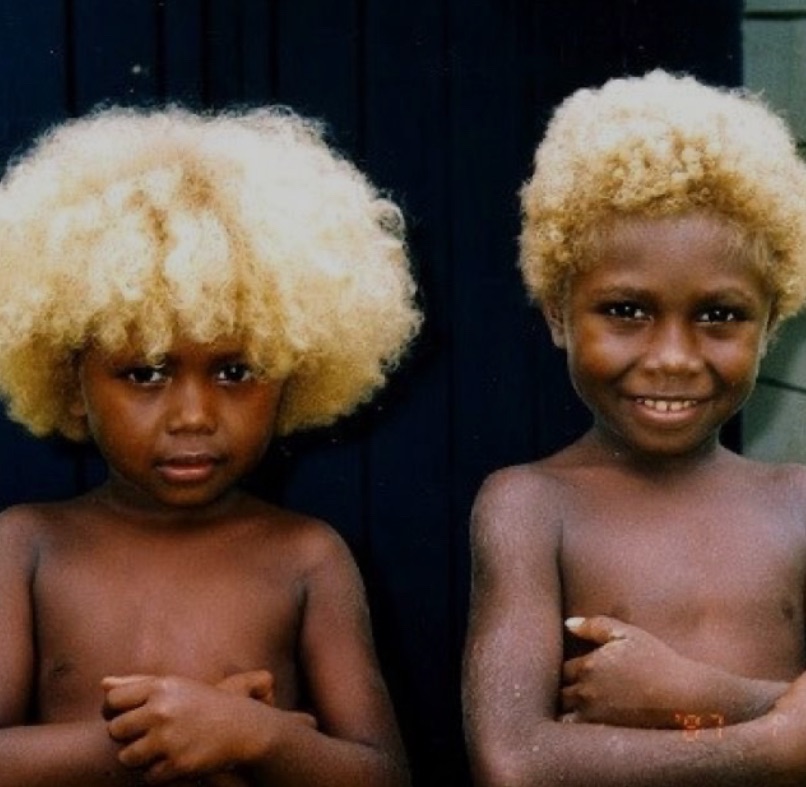
What red hair reveals about erased history, ancient migration, and hidden ancestry
In many Black families across the Americas, there’s always one:
A child or elder with burnt copper curls, auburn tones, or bright red hair that seems to come out of nowhere.
It’s often dismissed as a genetic fluke or blamed on European ancestry.

But what if red hair in Black and Indigenous peoples isn’t an accident?
What if it’s a genetic breadcrumb—leading us back to a forgotten global lineage?
The Red and Copper Hair That Doesn’t Fit the Narrative
Colonial science tells us that red hair is a recessive European trait.
But that doesn’t explain why:

Melanesians in the Pacific have dark skin and naturally blonde or red hair Australian Aboriginals and Andamanese islanders exhibit reddish and coppery hair with no European contact South American tribes, such as some Amazonian and Peruvian groups, have passed down red hair for generations And why in Black American families, red hair appears across generations—often in the absence of any known European parentage
Clearly, something deeper is going on.

What Science Isn’t Asking: Where Did the Red Come From?
Red hair is tied to the MC1R gene, located on chromosome 16.
This gene mutation is not exclusive to Europeans—it has arisen in multiple ancient populations, likely long before race as we know it existed.
Some geneticists now propose that red hair:
May have been present in early human populations across various continents Could have developed independently in isolated groups, such as Melanesians Is linked to unique blood type distributions and metabolic traits, suggesting more than just aesthetic variation
In short, red hair is a marker of ancient human diversity—not European ancestry.
Ghost DNA: The Genetic Echo of Erased Ancestors
Recent genetic studies have identified what scientists call “ghost DNA”—ancient genetic material found in modern humans that doesn’t match Neanderthals, Denisovans, or any known human ancestor in the fossil record.
This ghost DNA is found in:
West Africans Melanesians and Aboriginal Australians Amazonian and Andean tribes And increasingly, in descendants of Black and Indigenous communities in the Americas
What does this mean?
It means there was a lineage of ancient humans—possibly seeded or originating on Earth—who left no skeletons, only genetic whispers.
And when red hair appears in these same communities, especially alongside rare blood types and spiritual oral traditions, it’s not just coincidence—it’s a signal.
You may be carrying the DNA of people who predate the great flood, the slave trade, and even the written word.

Red Hair in Black American Families: A Hidden Heritage
In the U.S., many people with red hair and melanin-rich skin have heard family members say:
“It skips a generation.” “It runs in our family.” “My grandma had hair like fire.”
Often, these families have roots in the Southeast—Louisiana, Georgia, Mississippi, the Carolinas.
These regions were home to reclassified Indigenous tribes like the Washitaw, Blackfoot East, and Yamasee—nations with ancestral connections predating the transatlantic slave trade.
So the red hair may not be “white blood.”
It may be a remnant of a people we were taught not to see.

A Shared Trait Across Global Indigenous Peoples
Across continents, red hair shows up in:
Melanesians with volcanic island ancestry Amazonian tribes in Brazil and Peru Australian Aboriginals with ties to oral flood traditions African desert tribes, such as the Tuareg and Fulani, known for reddish hues and non-Arab phenotypes
Each of these peoples carry ancestral memories of being here before colonization, before conquest, before borders.
Red hair is not just a feature—it’s a living signature of Earth’s first peoples.
Red Hair, Ghost DNA, and Eugenics Erasure
Eugenics targeted not only skin color but “undesirable traits” like:
Red or copper hair in non-white people Unusual eye color Elongated skulls, Aboriginal features, and markers of ancient lineages
Rather than acknowledge that these traits pointed to precolonial Aboriginal ancestry, eugenicists labeled them as “degenerate mutations” or signs of “racial mixing.”
In truth, they were signs of ancestral survival.
Sterilization and the War on Indigenous Wombs
From the 1920s through the 1970s:
Thousands of Black and Native American women were forcibly sterilized in the U.S. In Latin America, Indigenous women were sterilized to prevent the continuation of “undesirable bloodlines” Many of these victims carried oral traditions, cultural memory, and genetic markers that tied them to pre-flood civilizations and land stewardship
Eugenics wasn’t just about race—it was about spiritual erasure.
What They Couldn’t Kill Lives in You
If you or your family carry:
Red or copper hair Unusual ancestry stories Indigenous oral traditions A sense of “otherness” in your blood Then you may be the living embodiment of a bloodline that survived centuries of biological warfare, on land and in law.
Your very existence challenges the idea that history was ever theirs to write.
What This Means for You
It’s time to reconsider:
Who told you what your ancestry was? What histories were left out of your textbooks? What part of your identity was erased to fit into simplified categories like “Black” or “African American”?
Red hair might be one clue in a much bigger puzzle—connecting you to a lineage older than colonization, older than slavery, older than borders.
You Are Not a Mystery—You Are a Remnant
You are not a genetic accident.
You are the living continuation of a people who remembered the fire before the flood.
Your hair tells a story your history books don’t.
The more you learn to read it—the more you reclaim the truth of who you are.
Livity.Blog | Hidden Histories. Ancestral Intelligence.
Find us on YouTube: youtube.com/@LivityBlog
Join us on Livity.blog to rediscover the wisdom of Aboriginal heritage, unveil hidden histories, and empower Indigenous futures. Together, let’s honor the past to inspire a brighter tomorrow.
Rooted in ancestral truth, unveiling hidden legacies, and nurturing the spirit of Indigenous resilience.
Here are references to support your Livity.Blog article “Red Hair in Black Communities: Tracing the Forgotten Bloodlines of Black and Indigenous Peoples”:
Scientific & Genetic References:
Harding et al. (2000) – “Evidence for variable selective pressures at the human MC1R gene.” → MC1R gene mutation, responsible for red hair, arose independently in multiple populations. https://pubmed.ncbi.nlm.nih.gov/10802651
Crawford et al. (2017) – “Reconstructing the Population Genetic History of the Caribbean.” → Traces of Indigenous ancestry found in Afro-descendant populations in the Americas. https://www.cell.com/ajhg/fulltext/S0002-9297(17)30138-3
Skoglund et al. (2015) – “Genetic evidence for two founding populations of the Americas.” → Discovery of Australo-Melanesian–related ancestry (Population Y) in Amazonian tribes. https://www.nature.com/articles/nature14895
Hajdinjak et al. (2018) – “Reconstructing genetic history with ancient DNA.” → “Ghost lineages” show up in the genomes of modern humans without matching fossil records. https://www.cell.com/current-biology/comments/S0960-9822(18)31383-9
Malaspinas et al. (2016) – “A genomic history of Aboriginal Australia.” → Confirms ancient divergence and continuity of Aboriginal Australians with red hair phenotypes. https://www.nature.com/articles/nature18299
Cultural & Historical References:
Deloria, Vine Jr. – “Red Earth, White Lies: Native Americans and the Myth of Scientific Fact” → Argues for alternative Indigenous histories hidden by colonial narratives.
J.A. Rogers – “Nature Knows No Color-Line” → Documents physical and cultural features (including red hair) of Black and Indigenous peoples across time and continents.
William Loren Katz – “Black Indians: A Hidden Heritage” → Chronicles the intersection of African and Indigenous peoples in North America, including reclassification and forgotten identities.
