
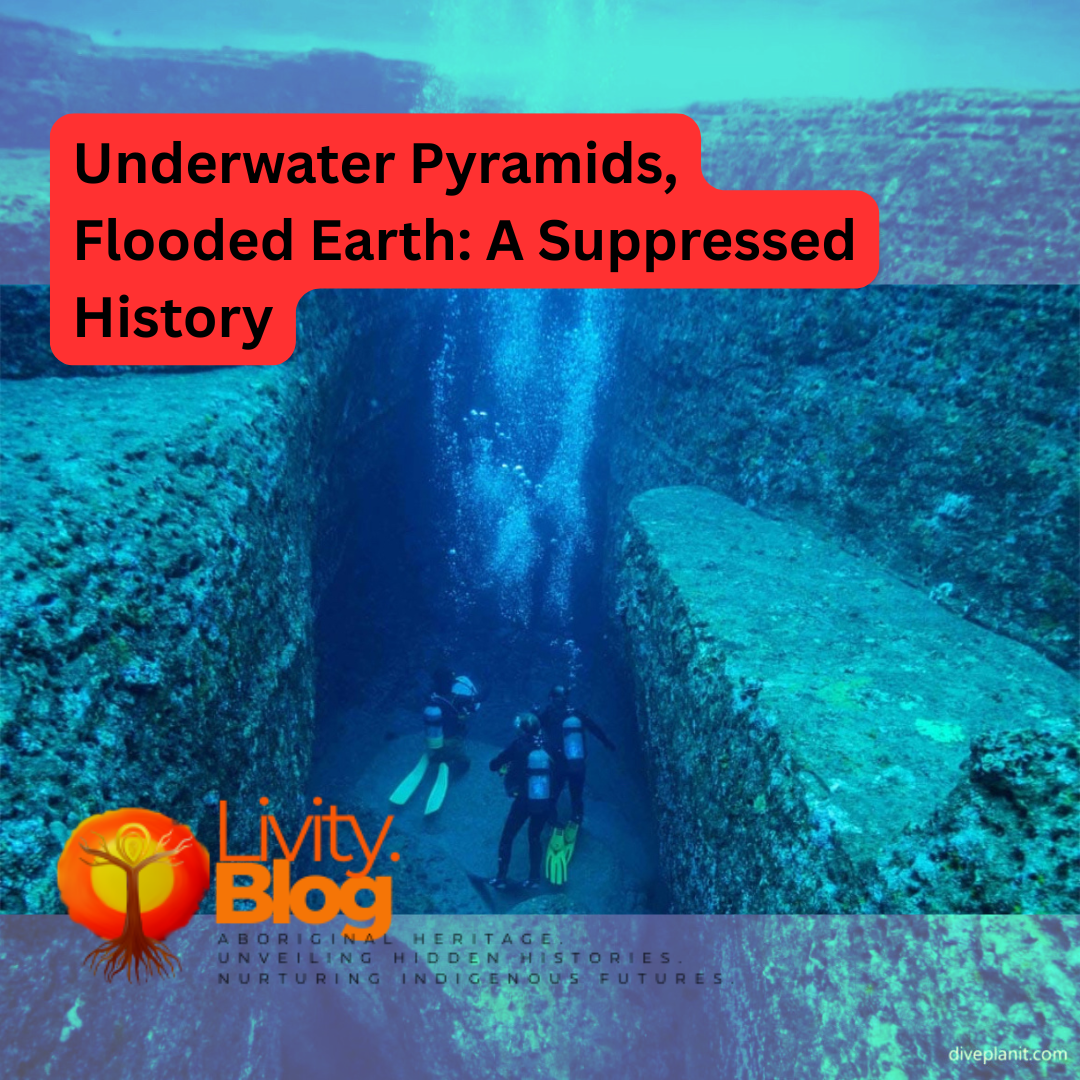
An alternate worldview: Earth submerged and pyramids built underwater

Propose Earth was once mostly covered by water—perhaps even long into the era of early civilization—and that pyramids and megalithic complexes were deliberately constructed under or partially under water, long before rising seas submerged them. This viewpoint challenges mainstream archaeology as being shaped by colonial agendas and gatekeeping of knowledge.
Fringe observations of underwater pyramid‑like structures

Yonaguni Monument (Japan): A large stepped rock formation offshore that some alternative researchers say bears evidence of human carving with terraces and what looks like erosion by rising sea levels. Cuban Underwater Formations: Sonar data from around 2001 revealed large geometric shapes off Cuba’s coast—possibly granite blocks or pyramidal forms. The discoverers suggested artifacts of an unknown civilization, though experts urged caution pending physical excavation. Bimini Road (Bahamas): A submerged limestone pavement often cited in pseudo‑archaeology as artificial. Early radiometric dates were later challenged due to recrystallization invalidating the result; mainstream science attributes it to natural beachrock formation.

Evidence of water erosion and salt encrustation at Giza?
A controversial 2025 claim by an Italian‑Scottish research team asserted that radar scanning revealed a vast subterranean network of chambers under the Giza plateau—possibly tied to a civilization around 38,000 years ago, destroyed during a catastrophic flood 12,000 years ago. The lead researcher also pointed to erosion marks and salt crusts on pyramid stones as evidence they were submerged in ancient floodwaters . Mainstream archaeologists have rejected these conclusions as unverified and methodologically unsound.
Flood myth resonance and ancient deluges
Black Sea deluge hypothesis: William Ryan, Walter Pitman and others propose a catastrophic inflow of Mediterranean water into the Black Sea basin around 7,600–8,800 years ago, possibly inspiring flood legends. Sediment cores, drowned valleys, and early underwater archaeology support the idea of a rapid, dramatic inundation in the early Holocene . Critics argue the rise may have been gradual and archaeological impact minimal. Local Mesopotamian deluges: Scientific interpretations suggest major floods in southern Mesopotamia around 2900 BCE created widespread water deposits and lake formations. While not global, these events match key themes of Genesis flood tradition.
Pyramids as vaults or recovery architecture
Current speculative models—outside accepted Egyptology—include the idea that pyramids weren’t simple tombs, but constructed as vaults or surviving structures built during or after catastrophe. One fringe theory by Scott Creighton proposes pyramids were recovery vaults to preserve civilization in a post‑deluge world. Other mythic‑alternative thinkers (e.g. Graham Hancock) see pyramids as heritage from pre‑flood civilizations destroyed by asteroid‑induced Younger Dryas events.
Mainstream archaeology often dismisses non‑orthodox theories as pseudoscience. Yet what if its assumptions are shaped by colonial mindsets? Consider a world where Earth wasn’t initially dominated by dry land, but by water—and pyramids were engineered underwater by civilizations lost to drowning floods.
A Blue Planet – Water as Foundation
Geology tells us early Earth was once up to 90 % ocean. Ancient sea level changes dramatically shaped coastlines. Mythologies of deluge—Noah, Deucalion, Manu—may echo memories of real catastrophic influxes.

Signs Beneath the Waves
From Yonaguni to Cuba’s sonar anomalies, ocean floors reveal forms reminiscent of architecture. While dismissed as natural at present, few have been physically excavated. Could geometric underwater masses mark lost civilizations?
Giza and the Watery Enigma
In 2025, independent theorists sparked controversy by claiming radar-detected chambers kilometers beneath Giza, alongside signs of water erosion and salt encrustation on pyramid blocks—suggesting submersion in a mega‑flood around 12,000 years ago . Although mainstream experts reject these methods, the questions raised align with alternative flood histories.

Deluge and Civilizational Collapse
The Black Sea deluge (~8,000 BP) may have destroyed coastal communities and could be the kernel of the Noah story . Together with Mesopotamian mega‑floods (~2900 BCE) evidenced in sediments and ancient lakebeds, they show that floods have struck human populations repeatedly.
Pyramids as Post‑Flood Vaults
Some alternative theories view pyramids not as tombs but as vault‑like refuges, intended to survive deluge and preserve knowledge—whether built pre‑flood or as rescue monuments after catastrophe. These ideas challenge mainstream explanations rooted in state funerary traditions.
Suppression or Dismissal?
Many of these ideas originate outside academia, often dismissed for lack of peer‑review. But history shows that colonial institutions have sidelined indigenous or alternative narratives. The silence of excavation data around these underwater sites raises questions: are we failing to explore, or intentionally avoiding?
Conclusion:
This theory reframes human history through a lens of watery cataclysm and submerged architecture. While mainstream science doesn’t endorse it, the overlap in certain geological data, myths, and unexplained anomalies offers a foundation worth deeper exploration—if we’re ready to question prevailing assumptions.
📌 Additional Evidence & References
Cuban underwater formations interpreted via sonar as possible man-made stone blocks—but not yet excavated… Radar‑based subterranean mapping beneath Giza claiming water erosion features and chambers of earlier builders, dated 38,000 years BP and flood event ~12,000 years ago Black Sea deluge hypothesis explaining flood traditions, with geologic and sedimentary support Mesopotamian regional floods offering scientifically dated flood layers, possible origin for Genesis narratives Pseudo‑archaeological models positing pyramids as recovery vaults built to survive flood catastrophes
⚠️ Considerations and Next Steps
These hypotheses rest on limited data; most have not undergone rigorous excavation or peer‑review. Many claims—Yonaguni, Bimini, Giza subterranean chambers—are disputed by experts referencing natural geology, dating errors, or misinterpretation of radar/sonar signals.
🔍 Final Takeaway
The truth may lie not in orthodox textbooks, but sometimes beneath the waves—waiting for an open mind to dive deeper.
References
Ryan, W. B. F., & Pitman, W. C. (1999). Noah’s Flood: The New Scientific Discoveries About the Event That Changed History. Simon & Schuster.
Ballard, R. D., Coleman, D. F., & Rosenberg, G. D. (2000). “Further Evidence of Abrupt Holocene Drowning of the Black Sea Shelf.” Marine Geology, 170(3–4), 253–261.
Hancock, G. (2015). Magicians of the Gods: The Forgotten Wisdom of Earth’s Lost Civilization. St. Martin’s Press. Kimura, M. (1997). “Submarine topography of the Yonaguni Monument.”
Okinawa Prefecture Research Report. Lewis, T. (2001). “Possible Lost City Found Under Cuba’s Waters.” National Geographic News. Retrieved from https://www.nationalgeographic.com
Aksu, A. E., Hiscott, R. N., & Yasar, D. (2002). “Persistent Holocene Outflow from the Black Sea to the Eastern Mediterranean Contradicts Noah’s Flood Hypothesis.”
Marine Geology, 190(1–2), 1–18. Schoch, R. M. (2002). “Redating the Great Sphinx of Giza, Egypt.” Geological Society of America Abstracts with Programs, 34(7), 533. UNESCO (2020). “Underwater Cultural Heritage and Submerged Archaeological Sites.”
UNESCO Reports on Marine Heritage. News.com.au (2025). “Vast Ancient City May Be Buried Beneath the Pyramids of Giza.” Retrieved from https://www.news.com.au Wikipedia contributors. (2025).
Yonaguni Monument. In Wikipedia. Retrieved from https://en.wikipedia.org/wiki/Yonaguni_Monument Wikipedia contributors. (2025). Cuban underwater formation. In Wikipedia. Retrieved from https://en.wikipedia.org/wiki/Cuban_underwater_formation
