
The “Ghost Population” Science Tried to Erase
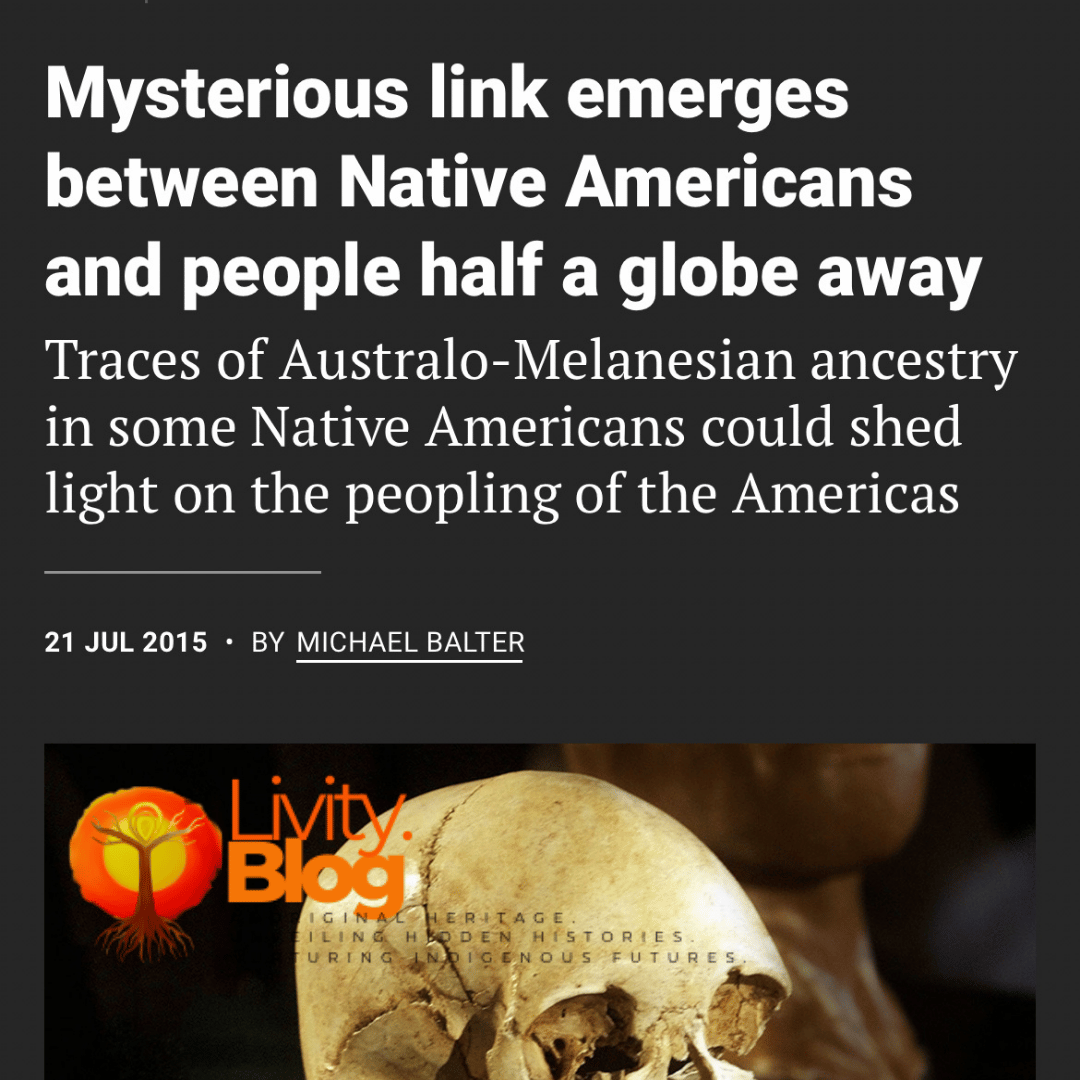
In 2015, geneticists made a discovery that should have rewritten everything we thought we knew about the peopling of the Americas. They found something extraordinary in the DNA of Amazonian peoples—the Karitiana, Suruí, and Xavante: a genetic signature linking them directly to Indigenous Australians, Melanesians, and the Andaman Islanders.
They called it “Population Y,” from the Tupi word Ypykuéra, meaning “ancestor.”
This wasn’t a minor genetic whisper. This was 1-2% of the entire genome showing deep affinity with the dark-skinned peoples of Oceania—peoples separated by the entire Pacific Ocean. And in 2021, new research revealed the signal was even more widespread than originally thought, appearing not just in Amazonian communities but also among the Chotuna people of Peru’s Pacific coast, the Guaraní Kaiowá of central-west Brazil, and the Xavánte near Brazil’s center.
The implications are staggering. But before we dive deeper, we need to understand what this discovery really means—and why it matters to every Indigenous person whose ancestors were declared “extinct.”

Who Are the Melanesians?
Melanesia means “place of Black people”—islands in the South Pacific including Papua New Guinea, Fiji, Solomon Islands, Vanuatu, and New Caledonia. The term was given by Europeans who needed to categorize what they saw: dark-skinned peoples with tightly coiled hair, brilliant seafaring cultures, and complex societies that predated European “discovery” by tens of thousands of years.
These were the original peoples of the Pacific, descendants of some of the first humans to leave Africa. They were master navigators, reading stars and ocean currents to traverse thousands of miles of open water. The so-called “Afro” hairstyle? It originated in Fiji.
But here’s what colonial anthropology tried to hide: Melanesians didn’t just populate the Pacific islands. Their DNA tells us they traveled much, much farther.

The Discovery That Changed Everything
The 2015 studies analyzed DNA from over 200 living and ancient Indigenous peoples across the Americas. What they found in Amazonian populations was unmistakable—a genetic signature unlike anything else in the Americas, but perfectly matching the genetic profile of peoples from Australia, Melanesia, and the Andaman Islands.
Scientists were baffled. How could people from opposite sides of the world share such specific genetic markers? The prevailing narrative said all Native Americans descended from Siberian populations who crossed the Bering Land Bridge around 15,000 years ago. This Australasian signal didn’t fit that story.
But the 2021 research from the University of São Paulo went even further. Lead geneticist Tábita Hünemeier and her team analyzed genetic data from 383 individuals across South America—438,443 genetic markers in total. What they discovered rewrote the map:
The Y signal wasn’t limited to the Amazon. It appeared in:
- Chotuna people of Peru (Pacific coast)
- Guaraní Kaiowá of central-west Brazil
- Xavánte of central Brazil
- Multiple Amazonian groups
This meant the Australasian presence in South America was far more extensive than anyone had imagined. These weren’t random genetic anomalies. This was evidence of an entire ancestral population—Population Y—whose descendants spread across the continent.

The Migration Routes: How Did They Get Here?
Here’s where it gets fascinating. The research suggests at least two waves of migration carrying the Y signal:
First Wave (15,000+ years ago): The earliest migrants with Australasian ancestry likely traveled along the Pacific coastal route. They were adapted to maritime life, sticking to the coast as they moved south from Beringia. These coastal settlers became the ancestors of groups like the Chotuna.
Second Wave (8,000-15,000 years ago): A second group with the same Australasian heritage migrated eastward from the Pacific coast, moving inland to settle in the Amazon basin and central Brazilian plateau. This explains why the signal appears in both coastal and interior populations.
But here’s the critical question: How did Australasian genes get into people crossing from Siberia?
The answer challenges everything we thought we knew about ancient human migration.
The Beringian Connection: Ancient Coupling in Northeast Asia
The latest research suggests that the Australasian genetic signature didn’t come from people sailing directly across the Pacific (though Melanesian seafaring skills make that less impossible than mainstream archaeology wants to admit). Instead, the evidence points to something equally profound:
Ancient populations from Southeast Asia—the ancestors of today’s Melanesians and Aboriginal Australians—migrated into Northeast Asia and Siberia, where they coupled with the populations preparing to cross into the Americas.
In other words, the ancestors of Population Y were already mixed—carrying both Siberian and Australasian heritage—before they ever set foot in the Americas. “It is as if these genes had hitched a ride on the First American genomes,” explained the researchers.
This means that people we would recognize as having Melanesian features—dark skin, broad noses, coiled hair—were among the very first peoples to enter the Americas. Not as a “second wave” that came later, but as part of the original founding populations.

The Luzia Woman: Physical Evidence of Melanesian Features
Remember Luzia? In 1973, archaeologists discovered a 13,000-year-old skeleton in Lagoa Santa, Brazil—the oldest human remains found in the Western Hemisphere at that time.
Her skull didn’t look Native American by modern standards. It looked Aboriginal Australian. Broad, robust features. The kind of morphology you see in Melanesian peoples.
For decades, scientists debated what this meant. Some suggested separate migrations. Others claimed genetic drift could explain the differences. But when you look at Luzia alongside the Population Y genetic data, a clearer picture emerges: The first South Americans included people who looked Melanesian because they carried Melanesian ancestry.
Other ancient remains from Lagoa Santa—the Laranjal and Moraes skeletons—showed similar features. And their closest living Amerindian relatives? The Yaghan of Tierra del Fuego and the extinct Pericú of Baja California—populations at the extreme southern and northern edges of the initial coastal migrations.
The physical evidence and the genetic evidence are telling the same story.
Why Don’t We See This Signal in North America?
This is one of the most intriguing mysteries. If these Australasian-descended peoples traveled through North America to reach South America, why don’t we find the Y signal in Indigenous North American populations?
The research offers two possible explanations:
1. The Coastal Route Hypothesis: The migrants carrying the Y signal may have stuck closely to the Pacific coast, moving south rapidly without extensively mixing with interior populations. By the time they reached South America 14,800 years ago (evidence from Monte Verde, Chile), they had maintained their distinct genetic signature.
2. The Extinction Hypothesis: Some researchers suggest that Indigenous populations carrying the Y signal in North America may have been wiped out by later migrations or by European colonization. If these peoples lived primarily along coasts—which were heavily targeted during colonization—their genetic legacy may have been erased from the North American record.
Or perhaps—and this is crucial—we simply haven’t looked hard enough yet. The Y signal was “impossible” in the Amazon until 2015. It was “limited to the Amazon” until 2021. How many other Indigenous populations carry markers we haven’t studied because we assumed we already knew their history?

What This Means for Caribbean Indigenous Peoples
Now let’s bring this home to the Caribbean.
If Melanesian-descended peoples were migrating along coastlines throughout the Americas, and if they reached as far south as Tierra del Fuego and as far inland as the Brazilian plateau, is it really so impossible that they also reached the Caribbean islands?
The colonial narrative declares Caribbean Indigenous peoples “extinct.” But what if that extinction story was always a lie designed to justify ongoing colonization and erasure?
Consider:
- Maritime adaptation: Population Y peoples were coastal, seafaring populations. The Caribbean is an archipelago. These were exactly the kinds of environments they thrived in.
- Morphological evidence: Historical accounts describe Indigenous Caribbean peoples with varied features, including some with characteristics that don’t match the narrow “Native American” stereotype.
- Cultural connections: Seafaring traditions, sophisticated astronomy, complex societies—all hallmarks of both Melanesian and Caribbean Indigenous cultures.
- Genetic isolation: The Y signal shows up in very specific populations. Has anyone conducted extensive genetic studies of Caribbean peoples with this in mind? Or have we been told there’s “nothing to find” because Indigenous peoples are “gone”?
The Politics of “Ghost Populations”
Let’s be clear about something: calling Population Y a “ghost population” is political language.
These aren’t ghosts. These are our ancestors, written into our DNA, proven by science. But calling them “ghosts” makes them seem mysterious, unknowable, perhaps not quite real. It allows mainstream science to acknowledge the evidence while still maintaining the colonial narrative of Indigenous extinction.
Notice how the language shifts:
- When Europeans are found everywhere, it’s called “exploration” and “migration”
- When Indigenous peoples are found everywhere, it’s a “mystery” requiring special explanation
- When Black and brown peoples show unexpected connections, suddenly there are “ghost populations” rather than simply acknowledging: We traveled. We connected. We were everywhere.
The Polynesian peoples—who look more “Asian” to European eyes—maintain their reputation as “great seafarers.” But Melanesians? Despite the same seafaring traditions, the same sophisticated navigation, the same evidence of long-distance travel? They’re ghosts.
This is the colonial taxonomy at work: deciding which Indigenous peoples get to claim their own histories and which must have their presence explained as anomalies.
What the Controversy Really Reveals
Since 2015, there’s been pushback against the Population Y findings. Some researchers argue the signal could be explained by ancient East Asian populations (like the 40,000-year-old Tianyuan man) rather than Australasian ancestry. Others suggest it’s all genetic drift and coincidence.
But here’s what’s interesting: The controversy itself reveals colonial anxiety about Indigenous connectivity.
Why is it so hard to accept that ancient peoples could have traveled, mixed, and shared ancestry across vast distances? We know Melanesians reached Australia at least 50,000 years ago—a journey requiring sophisticated boats and navigation. We know they settled islands across the Pacific. Why is South America impossible?
The real issue isn’t the evidence—it’s the narrative. If Indigenous peoples were mobile, connected, and present across vast geographies, then the colonial story of empty lands waiting to be “discovered” collapses. If Black and brown peoples were the first Americans, carrying Melanesian features and ancestry, then the racial hierarchies built by colonialism lose their foundation.
The Y signal threatens more than academic theories. It threatens the legal and political structures built on Indigenous “extinction.”

For Our Daughters, For Our Ancestors
This research isn’t just academic. It’s personal.
Every time a geneticist traces the Australasian signal deeper into South America, they’re confirming what Indigenous peoples have always known: We didn’t vanish. We didn’t become something else. We’re still here, carrying our ancestors in our blood.
For those of us with Caribbean Indigenous heritage, the Population Y findings open doorways. They force us to ask: If Melanesian-descended peoples were among the first to settle coastal South America, if they carried their dark skin and seafaring traditions across continents, if they spread from Peru to Brazil to the Amazon—why wouldn’t they have reached the islands?
And if they did reach the islands, and if colonial censuses deliberately reclassified them as “mixed,” “mulatto,” “Black,” or “extinct,” then perhaps the “mystery” of our ancestry isn’t mysterious at all.
Perhaps we’ve been Melanesian-descended Caribbean Indigenous peoples all along, carrying Population Y in our DNA while being told we don’t exist.
Moving Forward: Questions We Must Ask
The Population Y research opens new territories for investigation:
- Comprehensive Caribbean genetic studies: Has anyone looked for the Y signal in Caribbean populations with Indigenous ancestry claims? If not, why not?
- Morphological reexamination: How many historical accounts of “African-looking” Indigenous peoples were actually describing Melanesian features inherited from Population Y?
- Cultural connections: What are the links between Melanesian seafaring, navigation, and spiritual practices and those found in Indigenous Caribbean cultures?
- Colonial reclassification patterns: Did Spanish and other colonial censuses specifically reclassify darker-skinned Indigenous peoples as African or mixed to justify their enslavement?
- Modern DNA testing: What happens when Caribbean families who maintain Indigenous identity despite colonial denial get tested for Australasian markers?
These aren’t idle questions. They’re the foundation of our reclamation work.
The Evidence Continues to Grow
The 2021 findings aren’t the end of this story—they’re barely the beginning. As more Indigenous populations are studied, as more ancient remains are sequenced, as we develop better tools for detecting ancient ancestry, the picture will continue to sharpen.
What we know now:
- Population Y existed as a real ancestral group, not a statistical anomaly
- They were widespread across South America, not limited to one region
- They traveled coastally and then moved inland
- They were among the first peoples to enter and settle the Americas
- They carried Melanesian features in both genetics and morphology
What we’re learning:
- The signal appears in more populations as we study more Indigenous groups
- The migration patterns were complex, involving multiple waves and routes
- The genetic signature persists after 15,000+ years despite mixing with other populations
What we should investigate:
- Caribbean populations for Y signal markers
- Historical reclassification patterns of dark-skinned Indigenous peoples
- Cultural and linguistic connections between Melanesian and Caribbean Indigenous traditions
- The role of coastal migration routes in Caribbean settlement
Why This Matters for Livity
In Rastafarian philosophy, Livity means living in harmony with natural and spiritual law—recognizing the truth of who we are and where we come from. The Population Y research isn’t separate from Livity. It’s evidence of Livity.
Our ancestors traveled across oceans. They carried multiple heritages in their blood. They were Black, Indigenous, and connected to the original peoples of Africa, Australia, and Melanesia simultaneously. They didn’t fit into the neat categories colonialism tried to impose. They were complex, mobile, interconnected peoples who created vast networks of trade, culture, and kinship across the Americas.
When we reclaim our Indigenous identity, we’re not denying our Blackness. We’re acknowledging the full truth: Some of us have always been both. Our Indigenous ancestors may have carried Melanesian features because they were Melanesian-descended peoples who became Indigenous to these lands 15,000 years ago.
The colonial taxonomy that split us into “Indigenous” vs. “African” was designed to separate us from our land rights, our cultural practices, and our communities. But the DNA doesn’t lie. The ancient bones don’t lie. The migrations happened. The mixing happened. The survival happened.
Population Y is us. Ypykuéra—ancestor—written into our very cells.
Sources and Further Reading
Primary Research:
- Castro e Silva, M. A., et al. (2021). “Deep genetic affinity between coastal Pacific and Amazonian natives evidenced by Australasian ancestry.” Proceedings of the National Academy of Sciences, 118(14).
- Skoglund, P., et al. (2015). “Genetic evidence for two founding populations of the Americas.” Nature, 525, 104-108.
- Raghavan, M., et al. (2015). “Genomic evidence for the Pleistocene and recent population history of Native Americans.” Science, 349(6250).
Additional Context:
- “Earliest South American Migrants had Indigenous Australian, Melanesian Ancestry” – Science, March 29, 2021
- “Ghost Population Hints at Long-Lost Migration to the Americas” – Nature, July 21, 2015
- Indigenous Network: “Melanesians Came to the Americas and Left Descendants Here”
Related Livity.Blog Articles:
- The Colonial Reclassification Series
- Caribbean Indigenous Reclamation
- The Myth of Indigenous Extinction
- Blood Quantum and the Erasure of Dark-Skinned Indigenous Identity
Population Y isn’t a mystery. It’s evidence. Evidence that our Indigenous ancestors carried diverse heritages. Evidence that Black and brown peoples have been here since the beginning. Evidence that the categories colonialism created to divide us were always lies.
For our daughters who will grow up knowing: You come from peoples who crossed oceans, who survived ice ages, who carried the knowledge of stars and tides in their bones. You are Melanesian-descended, Caribbean Indigenous, African-diaspora—all of it, simultaneously, powerfully, undeniably.
For our ancestors who carried these genes through 15,000 years of survival: We see you. We remember you. We carry you forward.
Ypykuéra. Ancestor. Here in our blood, speaking truth to colonial erasure.
Livity Tree Art | Ancestral Wisdom | Cultural Reclamation
