
When they tell you Caribbean Indigenous peoples went “extinct,” they’re asking you to forget. When they say the Taíno, Kalinago, and Arawak “disappeared,” they’re demanding your amnesia. But on a small island in Bermuda, a community refused to forget for 350 years. And in their remembering, they’ve exposed one of colonialism’s most carefully hidden crimes: the systematic shipping of Native Americans from the mainland into Caribbean slavery.
This is the story of St. David’s Island. This is the story of how “extinction” was always a lie.

The Island That Remembered
St. David’s Island sits at the northeastern edge of Bermuda, so isolated that until 1934, you could only reach it by boat. For centuries, this isolation protected something precious: oral traditions that connected five families back to their origins as enslaved Native Americans shipped from New England in the 1600s and 1700s.
The elders spoke of an Indian slave woman named Susannah who claimed to be the granddaughter of King Philip—the Wampanoag leader Metacom who fought English colonists in 1675-1676. They remembered ceremonies at a place called Dark Bottom, where their ancestors danced around fires at night and sang in a language the colonizers couldn’t understand. Into the early 1900s, St. David’s elders still held these ceremonies, still chanted in that foreign tongue, still drummed the old rhythms.
The white Bermudians had a name for them: “Mohawks.” It was meant as an insult, a racial slur to mark the St. David’s people as different, as less than, as other. But that slur did something the colonizers didn’t intend—it preserved the knowledge that these people were Indigenous. That they were Native American. That they came from somewhere else.
What the colonizers didn’t know was that the St. David’s Islanders would one day read the very records the English kept to justify their enslavement. As current community historian St. Clair “Brinky” Tucker puts it: “The English kept great records. Little did they know that we’d read them.”
The Slave Ships That History Books Ignore

Here’s what those records reveal:
The Pequot War (1636-1638): After English colonists and their Narragansett and Mohegan allies massacred Pequot villages in Connecticut, survivors were sold into slavery. In 1637, Captain Anthony White, Bermuda’s largest landowner, purchased 80 Pequot captives and shipped them to St. David’s Island. They were put to work as farmers, boat builders, laborers, and fishermen.

King Philip’s War (1675-1676): This was the bloodiest war in colonial American history relative to population. When it ended, English colonists shipped hundreds—possibly over a thousand—Native Americans to the Caribbean as slaves. Historical records document shipments from Boston and Newport to Barbados, Jamaica, Bermuda, the Azores, Spain, and Tangier in North Africa.
The destinations were deliberate. As one scholar notes, Native Americans were shipped far from the mainland because colonists feared they knew the terrain too well and were “more prone to resistance or escape.” The Caribbean became “a dumping ground for these so-called ‘troublesome’ captives.”
Plymouth Colony’s records show the brutal logic: they were “eager to rid the colony of perceived threats while also profiting from the slave trade.” Even King Philip’s wife Wootonekanuske and their nine-year-old son were sold into slavery. Bermuda oral tradition says they were both sent to the island, where Wootonekanuske married an African slave, creating a bloodline that continues to this day.
The Scale: Between 1670 and 1715, Carolina traders alone exported an estimated 30,000 to 51,000 Native American captives to the Caribbean and other destinations. Historian Linford D. Fisher estimates that between 1492 and 1880, between 2 and 5.5 million Native Americans were enslaved in the Americas—in addition to 12.5 million enslaved Africans.
But here’s the thing about those numbers: they only count the ones who made it into the records. They don’t count the ones who were reclassified.
Colonial Reclassification: The System That Made Us “Disappear”
This is where my work on Colonial Reclassification Systems connects directly to the St. David’s story.
When Native American slaves arrived in the Caribbean, they didn’t stay “Indian” in colonial records for long. Here’s why:
The 2011 DNA Study: Researchers from the University of Pennsylvania studied 111 St. David’s Islanders. The results showed that “the majority of mitochondrial DNA and Y-chromosome haplotypes are of African and West Eurasian origin.” Only two individuals showed detectable Native American ancestry in that particular study.
Colonial authorities would have looked at these results and declared: “See? They’re not really Indian. They’re Black. They’re mixed. They’re gone.”
But that’s exactly how the system was designed to work.
St. David’s was isolated until the 1930s, but it wasn’t sealed off. There was “intermarriage and cohabitation with African slaves, European colonists, and imported Carib Indians.” The English deliberately placed different enslaved populations together. They knew that within a few generations, the genetic markers would blend. Within a few more generations, census-takers could write “negro” or “mulatto” and claim the Native population had vanished.
But the culture didn’t vanish. The ceremonies didn’t vanish. The oral traditions didn’t vanish. The memory didn’t vanish.
This is what I mean when I talk about the Colonial Reclassification Series. The system didn’t just divide us into “Black,” “Hispanic,” and “Native American.” It created the conditions where Indigenous peoples who survived through strategic mixing with other populations would be erased from the record entirely. Your African ancestry became proof you weren’t Indigenous. Your European ancestry became proof you weren’t Indigenous. The fact that you survived became proof that you had disappeared.

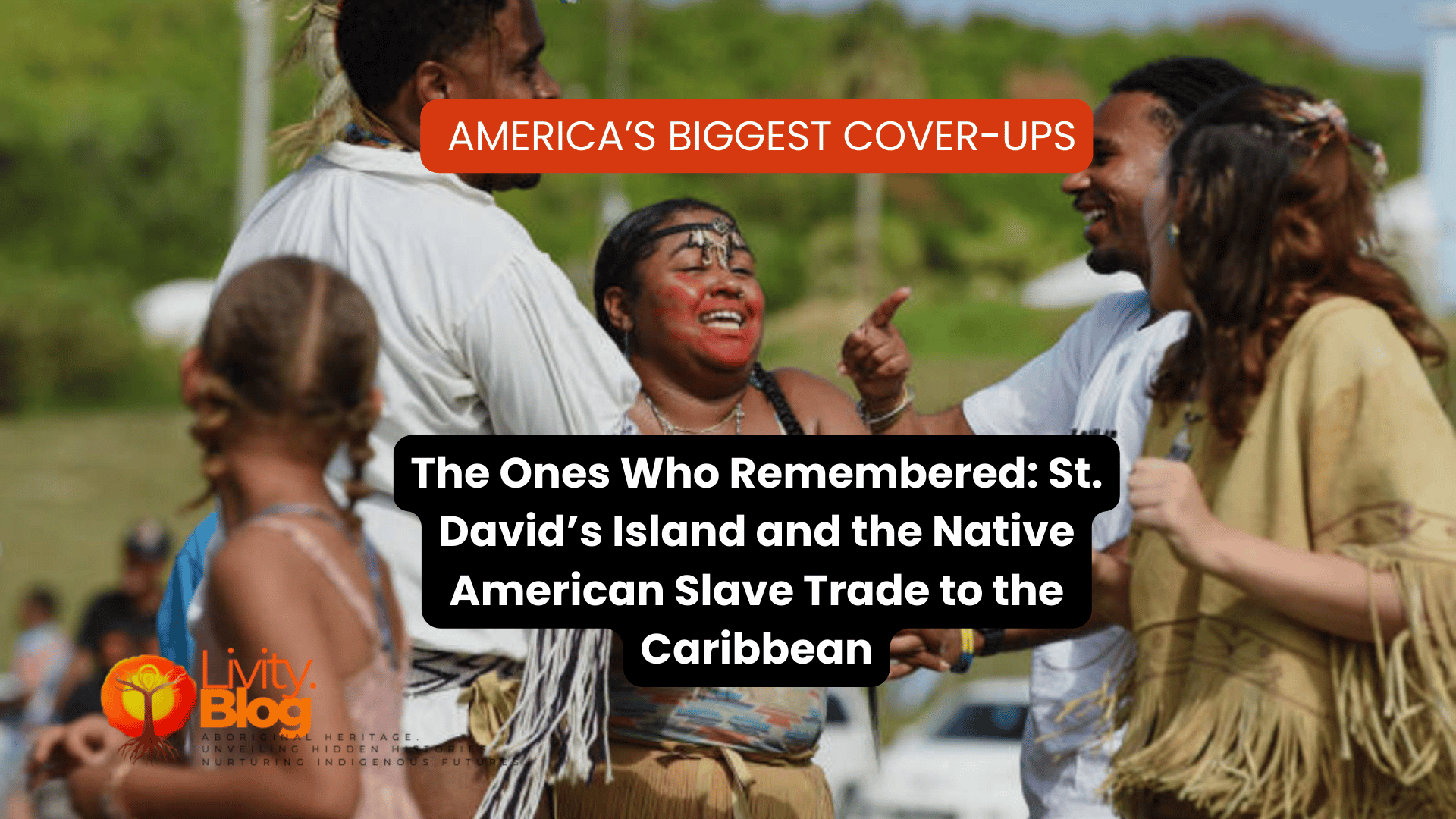
The biannual event of Bermuda’s St. David’s Reconnection Day, culturalsurvival.org
The Reconnection: When Ancestors Recognize Each Other
In 2001, something powerful happened. St. David’s Islanders reached out beyond their shores for the first time in centuries. They contacted tribes in New England—the Mashantucket Pequot, the Mashpee Wampanoag, the Narragansett.
In 2002, a delegation from these tribes traveled to Bermuda for the first Reconnection Indian Festival. They gathered at Dark Bottom, the historic ceremonial grounds. They stood in a circle, burned a fire, honored the ancestors, said prayers.
And when the mainland Indigenous peoples saw the St. David’s Islanders, they knew.
Michael J. Thomas, a Mashantucket Pequot tribal leader, said it simply: “I was struck by how much they looked like us.”
Not genetically—remember, the DNA study showed mostly African and European markers. But culturally. In the faces, the dances, the ceremonies. In the way they moved. In the way they honored their ancestors. In the way they remembered.
The ancestors recognized each other across 350 years of separation.
Since then, the St. David’s Islanders have held biannual powwows. They’ve maintained active relationships with their tribal cousins in Massachusetts, Rhode Island, and Connecticut. They’ve been included in the Smithsonian’s National Museum of the American Indian exhibits. They’ve trained in traditional practices like fishing, piloting, lobster-pot making, and drumming.
They’ve proven that you can’t DNA-test culture out of existence.
Why This Matters for All of Us
If you have Caribbean ancestry—especially if your family is from the Lesser Antilles, Barbados, Jamaica, or Bermuda—this history is your history.
The same ships that brought enslaved Africans brought enslaved Native Americans. The same plantation systems that erased African ethnic identities erased Indigenous tribal identities. The same colonial censuses that wrote “negro” over complex African lineages wrote “negro” over Indigenous lineages.
In Bermuda, the records specifically document Native Americans being shipped there. But what about all the other islands?
We know Native Americans were shipped to:
- Barbados (in such numbers that the island passed a law in 1676 specifically about New England Indian slaves)
- Jamaica (a major destination for Carolina’s Indian slave trade)
- St. Vincent (where they mixed with Africans to become the Garifuna people)
- The Leeward Islands (Antigua, Nevis, St. Kitts, Montserrat—all part of the same colonial administrative network)
But the smaller islands? The ones without detailed records? The ones like Montserrat, where my own family comes from?
The absence of documentation doesn’t mean it didn’t happen. It means the system worked exactly as designed.

What the St. David’s Community Teaches Us
Oral tradition is documentation. For 350 years, St. David’s families passed down stories that historians dismissed as myth. Then researchers checked the English records and found every detail confirmed. The elders were right all along.
Cultural identity outlasts genetic markers. You can measure DNA, but you can’t measure memory. You can’t measure ceremony. You can’t measure the recognition that happens when separated peoples finally see each other again after centuries and know—in their bones—that they belong to each other.
“Extinction” is a colonial administrative category, not a biological fact. The English needed us to be extinct so they could claim the land, justify the genocide, sleep at night. The fact that we survived through mixing, through hiding, through holding ceremonies in secret places like Dark Bottom—that survival became weaponized as proof of our disappearance.
Mixed ancestry is not dilution—it’s the evidence of survival strategy. Our ancestors did what they needed to do to keep the bloodline going. They married Africans, Irish, Europeans, other Indigenous peoples. They created new communities. They found ways to pass the knowledge forward even when the genetic markers became untraceable by colonial standards.
The bridges are still there. That’s why I call this work “Ancestral Bridges.” St. David’s Island is a bridge between the Northeastern tribes and the Caribbean. The Garifuna people are a bridge between St. Vincent’s Indigenous peoples and Central America. Every single one of us with Caribbean ancestry carries bridges in our blood—we just have to remember how to see them.
A Message to St. David’s Island
To Terlena Murphy, Brinky Tucker, and all the families of St. David’s who held the memory for 350 years when the world told you that you had disappeared:
Thank you.
Thank you for remembering when forgetting would have been easier. Thank you for holding the ceremonies when they called you “Mohawk” as an insult. Thank you for teaching your children who they were even when the DNA tests couldn’t measure what you knew in your bones. Thank you for reaching out across the ocean in 2001 to find your cousins again. Thank you for proving that cultural genocide only works if we consent to the amnesia.
You held a bridge for all of us. You proved that the “extinction” narrative is a lie. You showed us that oral tradition is documentation, that cultural identity does outlast genetic markers, that Indigenous peoples throughout the Caribbean and the Americas who were told we disappeared are still here.
We see you. We honor you. We remember with you.
What This Means for Caribbean Indigenous Reclamation
I started Livity Tree Art to create “medicine for cultural amnesia.” The St. David’s story is exactly what that medicine looks like when it works.
For those of us throughout the Caribbean who were told we’re “just Black,” “just mixed,” “just” anything that erases the Indigenous part of our ancestry:
The St. David’s model shows us the way forward:
- Trust the elders. If your grandmother said “we have Indian blood,” she wasn’t confused. She was remembering.
- Document what you can, but don’t wait for colonial archives to validate you. The records exist—sometimes you have to dig, sometimes you have to read between the lines, sometimes you have to accept that the absence of records is the record of systematic erasure.
- Build bridges with other Indigenous communities. The St. David’s reconnection with Northeastern tribes gave both communities something precious. We’re stronger together.
- Understand that mixed ancestry is not dilution. It’s survival. It’s strategy. It’s what our ancestors did to ensure we’d be here today.
- Ceremony is memory is resistance. When the St. David’s elders danced around fires and sang in that foreign language into the 1900s, they were practicing cultural warfare against colonial amnesia.
Livity
In Rastafari, “livity” means living in harmony with natural and spiritual law. It means rejecting Babylon’s systems. It means choosing life, memory, and connection over death, amnesia, and separation.
The St. David’s Islanders practiced livity for 350 years before they even knew the word. They chose to remember when the empire demanded forgetting. They chose to be Indigenous when the censuses wrote them down as something else. They chose to hold ceremonies in secret when it would have been safer to let the knowledge die.
That’s livity. That’s resistance. That’s medicine.
And now, as we enter an era where Indigenous peoples throughout the Caribbean are reclaiming our identities, reconnecting with severed lineages, and rebuilding the bridges colonialism tried to burn—the St. David’s story lights the way.
We were never extinct. We were never gone. We were just really good at surviving.
Resources for Further Research:
- Gaieski, J.B., et al. (2011). “Genetic ancestry and indigenous heritage in a Native American descendant community in Bermuda.” American Journal of Physical Anthropology
- Fisher, Linford D. (2017). “‘Why shall wee have peace to bee made slaves’: Indian Surrenderers During and After King Philip’s War”
- Reséndez, Andrés. (2016). The Other Slavery: The Uncovered Story of Indian Enslavement in America
- Tucker, St. Clair “Brinky.” (2009). St. David’s Island, Bermuda: Its People, History and Culture
- St. David’s Islanders & Native Community: [Contact information for those interested in learning more]
About the Author: Katherin Joyette is a Caribbean Indigenous artist, cultural worker, and founder of Livity Tree Art. Her work focuses on ancestral reclamation, decolonial education, and creating contemporary Aboriginal art as “medicine for cultural amnesia.” She is of Carib, Kalinago, Arawak, Eritrean, and Irish ancestry, with family lineage from Montserrat and St. Vincent.
Share this article. Tag someone who needs to know that “extinction” is a lie. Honor the St. David’s Islanders who held the memory. Remember with us.
#AncestralBridges #CaribbeanIndigenous #StDavidsIsland #ColonialReclassification #LivityTreeArt #IndigenousSurvival #NativeAmericanHistory #BermudaHistory #WampanoagNation #PequotNation #CulturalReclamation
