
ANCESTRAL INTELLIGENCE SERIES | COLONIAL RECLASSIFICATION
How the First-Line Peoples of the Americas Were Absorbed, Reclassified, and Hidden Inside the Slave Trade and Reclassification — And Why Racism Was the Specific Tool Required to Do It
Livity.Blog
“They did not erase the first people from the earth. They erased them from the archive. But you cannot erase a lineage from the blood. And you cannot erase a land claim from the land.”
— Ancestral Intelligence Framework, Katherin Joyette
There is a question that American history has never honestly answered: why did racism have to be so absolute — and why did it have to be built twice?
Why was the one-drop rule necessary? Why did the casta system in Spanish colonial America proliferate into over fifty racial categories — mulato, zambo, lobo, coyote, saltaatras — each one encoding a specific legal distance from whiteness? Why did two separate colonial empires, operating on different parts of the same continent, independently develop racial classification systems that were structurally identical in their function: absorb the dark-skinned peoples, strip them of their land claim, and place them in a legal category that defined them as arriving from somewhere else? Why, four hundred years after the first enslaved Africans arrived on American shores, does the United States still organize so much of its law, its economy, and its violence around a racial hierarchy that has no biological reality — and why does that hierarchy fall with such precision on the same people it was originally built to contain?
The standard answer is that racism was invented to justify slavery — that the European colonial project needed an ideology to rationalize the exploitation of African labor, and racial hierarchy provided that ideology. For the Spanish colonial project, the standard answer adds the justification of Indigenous land theft and labor extraction through the encomienda system. These answers are true. But they are not the complete truth. And the incomplete truth has kept the deepest wound in American history — one carried in the bodies of both the Black American community and the Latino community — from being named correctly for four centuries.
The Ancestral Intelligence framework proposes the complete truth: the British one-drop rule and the Spanish casta system were not separate colonial inventions born of separate colonial contexts. They were two versions of the same solution to the same problem — the problem of a people who would not yield the land because they knew, in their blood and their cosmology and their oral tradition, that it was theirs first. A people who were not conquered immigrants or recent arrivals but the oldest continuous human presence in this hemisphere. A people who had survived every catastrophe the ancient world had produced and were still standing when the Europeans arrived. Still fighting. Still remembering. And dark enough in complexion that both colonial systems could place them — along with the enslaved Africans brought to labor alongside them — into the non-white categories that held no land claim and no sovereignty.
To steal the land from people like that, you do not just need guns. You need to make them disappear from their own history. You need to place them inside a category that, by legal and social definition, holds no land claim, carries no prior presence, and arrived from somewhere else rather than growing from the earth itself.
In the British colonies and then the United States: you call them Black.
In the Spanish colonies and then Mexico and then the barrios of the American Southwest: you call them mestizo, mulato, Latino — you give them a national identity that celebrates their Indigenous past while stripping them of their Indigenous present.
And then you make both of those categories the most dangerous things a person can be in America. And you make sure the people inside them never look across the divide and recognize each other.
That is what this article is about.
Part One: The People Who Were Already There
The previous articles in this series have documented, through fossil evidence, genetic science, oral tradition, and burial archaeology, the presence of an ancient small-statured, dark-skinned substrate people in the Americas who predate the more widely recognized Beringian migration waves. The people buried in the Tennessee limestone graves. The Pedro Mountain mummy. The Makú of the Amazon with their language isolate. The Population Y genetic signal linking the most isolated Amazonian peoples to the Andaman Islanders, the Melanesians, and the Aboriginal Australians — the oldest human populations outside Africa.
These were not marginal peoples. They were the first-line peoples — the original substrate of human presence in this hemisphere. Small in stature, earth-connected in philosophy, cosmologically sophisticated, and by the time the European colonial project arrived, they had already survived thousands of years of pressure from the Beringian-descended nations who had expanded across the continent and displaced them from the river valleys, the open plains, and the most fertile lands.
They survived by doing what their ancestors had always done: going deeper into the mountain, deeper into the forest, higher into the rock. The Nimerigar of the Shoshone tradition — pushed to the high country. The Yunwi Tsunsdi of the Cherokee — in the deepest caves of the Appalachians. The small peoples of the Pedro Mountains, sealed in a cave in Wyoming. Still there. Still holding. Still remembering who they were.
These were not peoples who had ever been conquered. Their entire history was one of survival against forces that should have eliminated them — and had not. When the Europeans arrived, they were still here. And they were warriors who had been fighting for their existence since before recorded history began.
The nations that had absorbed them — including peoples like the Black Ute and other dark-complexioned Indigenous confederacies documented in early colonial records — carried their bloodlines, their land knowledge, and in many cases their specific resistance cosmology. The absorbed substrate peoples had not disappeared. They had gone inside the larger nations the way they had always survived: by becoming part of the fabric of the land itself, unrecognizable to outsiders, present to those who knew where to look.
The colonizer arrived and encountered this layered, ancient, warrior people. And realized, within the first decades of sustained contact, that the standard European conquest playbook was not going to work.
▸ Skoglund et al. (2015). Genetic evidence for two founding populations of the Americas. Nature, 525.
▸ Mooney, James. History, Myths, and Sacred Formulas of the Cherokees. Bureau of American Ethnology, 1900.
▸ Shoshone/Paiute Nimerigar oral tradition. 19th–20th century ethnographic record.
Part Two: Why They Could Not Be Conquered Conventionally
The Indian Wars lasted from the 1600s to 1924 — over three hundred years of sustained military campaign against peoples whom the colonial narrative simultaneously described as primitive, technologically inferior, and easily conquered. The California Genocide, officially recognized by the State of California in 2019, involved state government payments of bounties for Indigenous heads and scalps between 1846 and 1873. The United States Army conducted campaigns of deliberate starvation, destroying buffalo herds specifically to eliminate the food base of Plains nations. Biological warfare through the deliberate distribution of smallpox-infected blankets is documented in colonial correspondence.
You do not deploy three centuries of total war — starvation, biological warfare, state-sponsored bounty hunting, forced removal, and the deliberate destruction of children’s language and identity through boarding schools — against a sparse, primitive people who pose no serious resistance.
You deploy three centuries of total war against people who will not stop fighting.
The Cosmology of Non-Surrender
The first-line peoples — and the nations that had absorbed their lineage and their cosmology — carried a framework for their relationship to the land that made conventional surrender structurally impossible. Not as a tactical choice. As a cosmological reality.
In the European legal framework, land is property. Property can be purchased, sold, surrendered, traded, and legally transferred. A conquered people, in the European model, cedes their land through treaty and becomes a subject population within the conqueror’s legal system. This model had worked, with variations, across the European conquest of most of the world.
In the cosmological framework of the first-line peoples, the land was not property. It was the body of the ancestor. The soil of a specific territory held the bones of the people who had lived and died there for thousands of years. The river carried their ceremony. The mountain held their dead. The specific plants that grew in that specific place were the medicine that had been discovered and refined over generations of living in intimate relationship with that ground.
You cannot sell the body of your ancestor. You cannot sign a legal document transferring the right to stand on the grave of your grandmother. The framework does not exist within which such a transaction is coherent.
The colonizer interpreted this as stubbornness. As savagery. As evidence of inferior civilization that could not understand property law. What it actually was: a different and far older understanding of the relationship between a people and the earth they come from. An understanding that had been refined over tens of thousands of years of continuous presence on this specific ground. An understanding that was, from the colonizer’s perspective, not just inconvenient but existentially threatening — because a people who cannot conceptualize surrendering the land will never stop trying to take it back.
The first-line peoples could not surrender the land because surrender of the land was not a concept their cosmology contained. The land was the ancestor’s body. You can die on the ancestor’s body. You cannot give it to someone else. This was not stubbornness. It was the oldest law on Earth.
Warriors Who Had Always Been Warriors
The substrate peoples of the Americas — the small ancient first-line peoples and the nations that had absorbed them — were not warriors because of the colonial encounter. They were warriors because of their entire history before it.
They had survived the Pleistocene megafaunal collapse. They had survived the arrival of the Beringian migration waves and the displacement pressure of expanding agricultural and pastoral nations. They had been pushed to the mountain, the forest, the rock — and they had survived there too, developing the specific combat knowledge that comes from fighting for survival in terrain that larger, better-supplied armies struggle to navigate.
When the European military encountered them, they were fighting peoples who had been refining their survival and resistance strategies for thousands of years in the specific landscape being contested. The Spanish, the French, the British, and eventually the United States Army all discovered the same thing: conventional military tactics designed for open-field European warfare were catastrophically ineffective against peoples who knew every cave, every water source, every mountain pass, every seasonal migration route of every animal in their territory.
The Apache Wars alone lasted twenty-five years against a nation that never numbered more than a few thousand fighters. The Seminole Wars — three of them, spanning forty years — ended without a formal surrender. The United States declared victory and left approximately 300 Seminole people in the Everglades, unconquered, because the cost of going into that swamp to finish the job was too high. The Black Seminoles — a community that included escaped enslaved people, free Black people, and Indigenous peoples whose African and Native lineages had merged through decades of shared resistance — were specifically targeted as the most militarily effective element of the resistance because they combined Indigenous land knowledge with the particular ferocity of people who had already been enslaved once and were not going back.
▸ The California Genocide: official state recognition, 2019. California State Legislature, Assembly Concurrent Resolution 154.
▸ Seminole Wars historical record. National Archives. Three wars, 1816–1858. No formal Seminole surrender.
▸ Black Seminole resistance: Mulroy, Kevin. Freedom on the Border: The Seminole Maroons in Florida, the Indian Territory, Oklahoma, and Texas. Texas Tech University Press, 1993.
Part Three: The Three-Part Solution — Kill, Absorb, Rename
By the mid-1800s, the colonial project in the Americas had been running for nearly 400 years and the problem of the first-line peoples had not been solved. Military extermination campaigns were expensive, slow, and repeatedly produced resistance movements that outlasted the campaigns launched to suppress them. Treaty systems produced temporary agreements that were violated by the colonial side almost immediately, generating new cycles of warfare. Reservation confinement worked for peoples who accepted it — but the peoples who had never surrendered did not accept it, and the ones who did accept it sometimes produced the next generation of resistance leadership from within the reservation system itself.
The solution that emerged was not a single policy decision. It was a convergence of legal, military, economic, and social mechanisms that operated simultaneously across different registers — each one addressing a different aspect of the same fundamental problem. Together they constituted a three-part program: kill as many as possible, absorb the survivors into existing controlled populations, and rename them so that neither they nor anyone else would know what they were.
Part One of the Solution: The Extermination Campaigns
The targeting of the extermination campaigns was not random. The peoples most specifically pursued — the ones for whom bounties were paid, the ones against whom total war doctrines were applied, the ones whose villages were burned in winter to destroy their food supplies — were the ones who would not negotiate, would not relocate, and would not stop fighting.
This is documented in the military correspondence of the period with remarkable clarity. General Philip Sheridan’s statement — “the only good Indian is a dead Indian” — has been quoted so often it has lost its precision. Read it as a military doctrine rather than a slur and what it describes is a targeting policy: the Indian who is alive is the one who has not yet surrendered, and therefore the only solution the military system has for a non-surrendering people is elimination.
The peoples most targeted in the extermination campaigns were disproportionately the darkest-complexioned, most ancient-lineage, most land-rooted nations. The ones whose oral traditions most clearly encoded their prior presence. The ones whose resistance was cosmologically grounded rather than tactically provisional. The ones who were fighting not for tactical advantage but because surrender of the land was literally not a concept available to them.
Among these, the nations and communities that carried the absorbed lineage of the first-line substrate peoples — including the Black Ute, the Black Seminoles, the dark-complexioned mountain and forest peoples documented in early colonial accounts as belonging to no recognized tribal category — were specifically marked for elimination or dispersal, because they represented the convergence of the oldest land claim with the most effective resistance capability.
▸ Sheridan, Philip. Military correspondence, 1869. National Archives.
▸ Dunbar-Ortiz, Roxanne. An Indigenous Peoples’ History of the United States. Beacon Press, 2014.
▸ Black Ute historical record. Utah State Historical Society. Documentation of dark-complexioned Ute bands, 18th–19th century.
Part Two of the Solution: Absorption Into Controlled Populations
The survivors of the extermination campaigns faced a specific problem: they existed. They were alive. They were on the land or adjacent to it. They carried knowledge of the land that could not be entirely suppressed as long as they were alive to transmit it. And in many cases they were producing children who would grow up knowing what their parents knew.
The absorption mechanism worked through three channels simultaneously.
The first channel was the slave trade itself. Dark-skinned peoples with no recognized tribal affiliation, no treaty protection, no reservation land, and no colonial legal identity were vulnerable to being captured and sold into slavery regardless of their actual origin. The colonial slave trade was not precise about its sources. People who were Indigenous, or mixed Indigenous and African, or Indigenous peoples whose tribal structures had been destroyed by the extermination campaigns and who therefore had no institutional protection, were absorbed into the slave population and classified as African. Their children were born into slavery. Their grandchildren grew up knowing only that they were Black.
The second channel was the free Black and maroon communities. In the spaces at the edges of plantation society — the Dismal Swamp, the Florida Everglades, the mountain communities of the Appalachians and the Ozarks — escaped enslaved people, free Black people, and Indigenous peoples who had been stripped of their recognized tribal status formed communities together. These communities were mixed in ways that the colonial racial system worked hard to suppress and categorize. The children of these communities were classified as Black, as colored, as free Negro — regardless of how much Indigenous ancestry they carried.
The third channel was the boarding school system. For the peoples who remained in recognized tribal communities, the boarding school system — which operated under the explicit motto ‘kill the Indian, save the man’ — was specifically designed to sever the transmission of land memory, language, and lineage knowledge from one generation to the next. Children removed from their communities and forbidden to speak their languages grew up without the oral tradition that would have told them who they were and where they came from. Their children grew up further still from that knowledge.
The slave trade did not just steal African labor. It provided a legal category — Black, Negro, Colored— into which the surviving descendants of the first-line peoples of the Americas could be absorbed and made invisible. The category carried no land claim. It carried no prior presence. By legal and social definition, it arrived in chains. And that is exactly what it needed to do.
▸ Katz, William Loren. Black Indians: A Hidden Heritage. Atheneum, 1986.
▸ Forbes, Jack D. Africans and Native Americans: The Language of Race and the Evolution of Red-Black Peoples. University of Illinois Press, 1993.
▸ Pratt, Richard Henry. ‘Kill the Indian, save the man.’ Speech, 1892. National Conference of Charities and Correction.
▸ Tiya Miles. Ties That Bind: The Story of an Afro-Cherokee Family in Slavery and Freedom. University of California Press, 2005.
Part Three of the Solution: The Racial Category as Legal Technology
The construction of rigid racial categories in American law was not an accident of prejudice or a byproduct of economic convenience. It was a specific legal technology designed to solve a specific problem.
The one-drop rule — the legal principle that any African ancestry, however remote, classified a person as Black and therefore as property or as a legally inferior citizen — served a function that has nothing to do with biology or cultural identity. Its function was to prevent the absorbed descendants of the first-line peoples from ever successfully claiming Indigenous identity, land rights, or prior presence.
If a person is Black, by the one-drop rule, they cannot simultaneously be Indigenous. They cannot hold treaty rights. They cannot claim ancestral territory. They cannot assert sovereignty. The category is legally constructed to be mutually exclusive with every legal protection that Indigenous identity, however limited, might provide.
The Freedmen controversies — the ongoing legal battles over whether the descendants of enslaved people held by Indigenous nations have tribal citizenship rights — reveal this mechanism in its clearest form. Peoples whose ancestors were enslaved by the Five Civilized Tribes, and who in many cases were themselves of mixed Indigenous and African descent, have been denied tribal citizenship by the very nations whose ancestors enslaved them. The racial category assigned to their ancestors continues to function, 160 years after the formal end of slavery, as a barrier to the legal recognition of what the genetics and the oral traditions and the physical features of many of these families make obvious.
The racial category is not a description of a people. It is a cage built around a specific historical claim. And the claim it is built around is the oldest one in the hemisphere: we were here first. This is our land. And we have never stopped saying so.
▸ Forbes, Jack D. Africans and Native Americans. University of Illinois Press, 1993.
▸ Miles, Tiya and Sharon Holland, eds. Crossing Waters, Crossing Worlds: The African Diaspora in Indian Country. Duke University Press, 2006.
▸ The Cherokee Freedmen controversy: ongoing federal litigation, 1866 Treaty provisions, Cherokee Nation v. Nash.
Part Four: Racism as Land Theft Technology
This is the argument that the Ancestral Intelligence framework places at the center of its analysis of American racial history — and it is an argument that neither the mainstream civil rights framework nor the mainstream Indigenous rights framework has fully articulated, because each framework operates from within one side of a division that was deliberately constructed to prevent both sides from seeing the whole.
The Standard Framing and Its Limits
The standard civil rights framing of American racism is this: racism was invented to justify the exploitation of African labor. The transatlantic slave trade required an ideology that could rationalize the permanent, heritable enslavement of human beings, and racial hierarchy — the idea that African peoples were biologically inferior and therefore fit for servitude — provided that ideology. Racism is therefore a product of slavery, and the ongoing racial hierarchy in American society is the legacy of that original economic project.
This framing is true. But it is not complete. And the incompleteness matters because it makes racism appear to be a problem that ends when slavery ends — a legacy to be overcome through legal reform, economic redress, and cultural change. The persistence of racism beyond the formal end of slavery, and its resistance to every reform effort for the 160 years since, suggests that this framing is missing something essential about what racism is actually doing.
The standard Indigenous rights framing of American racism is this: Indigenous peoples were subjected to genocide and land theft by a colonial project that classified them as savages in order to deny them legal standing. The racial hierarchy applied to Indigenous peoples is different from the hierarchy applied to African peoples — one was about elimination, the other about exploitation — but both serve the colonial project of land and resource extraction.
This framing is also true. But it also misses the specific mechanism by which the two projects — the enslavement of African peoples and the genocide of Indigenous peoples — were connected through the racial category system in ways that have never been fully examined.
The Connection the Standard Framings Miss
The connection is this: the category of Black — the racial designation that placed a person outside of Indigenous rights, outside of treaty protections, outside of prior presence — was applied not only to African peoples brought to the Americas through the slave trade. It was also applied, systematically and deliberately, to the dark-skinned, ancient-lineage peoples who were already in the Americas and whose Indigenous identity would have given them a land claim that the colonial project could not legally accommodate.
The construction of Black as a racial category that is mutually exclusive with Indigenous identity was not accidental. It was the specific legal solution to the specific problem of peoples who were both dark-skinned and original — peoples whose presence predated the colonial project by thousands of years and whose cosmological and oral record could, if preserved intact, generate a land claim that no colonial court could fully dismiss.
By placing these peoples inside the category of Black — by classifying their children as Negro, as colored, as the descendants of slaves rather than the descendants of the land itself — the colonial legal system accomplished something that military extermination alone could not: it severed the legal and identity connection between a people and their prior presence on the specific land.
A dead Indigenous person is a tragedy that generates a record. A person classified as Black has, by the legal definition of the category, no Indigenous identity to be documented. Their children are Black. Their grandchildren are Black. And the land from which their great-grandparents were displaced is, legally and historically, empty — cleared not of people but of the category of people who could claim it.
Racism did not begin as an ideology and become a tool. It was always a tool. Specifically: the legal technology for converting a people with the oldest land claim in the hemisphere into a people with no legal identity that could hold a land claim. The ideology came after. The tool came first.
Why It Has to Be Maintained
This analysis explains something that the standard civil rights framework has always struggled to account for: why, 160 years after the formal end of slavery, does the racial hierarchy persist with such ferocity? Why does the United States continue to organize its policing, its economic system, its educational institutions, and its political processes around the maintenance of Black subordination, when the original economic rationale — slave labor — no longer exists?
The answer the Ancestral Intelligence framework proposes: because the original problem that racism was designed to solve has not been resolved. The land is still stolen. The lineage is still suppressed. And the absorbed descendants of the first-line peoples — the ones who were classified as Black specifically so that their land claim could not be legally asserted — are still here. Still carrying in their blood and their ancestral memory the trace of what was taken. Still producing, in every generation, people who feel in their bones a connection to this specific land that the official story of their origins cannot account for.
The ongoing violence of American racism is the maintenance of a suppression that is not yet complete. As long as the descendants of the first-line peoples exist — as long as there are people whose genetics carry the Population Y signal, whose family oral traditions include inexplicable Indigenous elements, whose bodies and faces do not fully match the African origin story they were given — the original problem persists. The land claim exists in the blood, even when it cannot be named in the archive.
Mass incarceration removes the most reproductively active generation from communities and from the land. Economic exclusion prevents the accumulation of the resources necessary to fund genealogical research, legal challenges, or cultural preservation. Police violence functions as the ongoing bounty system — the direct descendant of the colonial scalp bounties — targeting the same communities, the same bodies, the same resistance energy that the extermination campaigns targeted in the 19th century.
This is not conspiracy theory. This is institutional continuity. The mechanism was built with a specific purpose. It has not been dismantled. It continues to serve that purpose.
▸ Alexander, Michelle. The New Jim Crow: Mass Incarceration in the Age of Colorblindness. The New Press, 2010.
▸ Coates, Ta-Nehisi. The Case for Reparations. The Atlantic, June 2014.
▸ Dunbar-Ortiz, Roxanne. An Indigenous Peoples’ History of the United States. Beacon Press, 2014.
Part Five: The Descendants — Still Here, Still Carrying It
The most important argument in this article is not historical. It is present tense.
The descendants of the first-line peoples of the Americas are alive today. They were not completely exterminated. They were absorbed, reclassified, and hidden — but the lineage that was hidden is still there. It is in the genetics. It is in the oral traditions that survived in fragments through families who knew something about their origins that the official record did not account for. It is in the physical features of people who do not look fully African and cannot explain why. It is in the inexplicable connection to specific landscapes that people carry in their bodies even when they have no documented ancestral connection to those places.
The Afro-Indigenous Community — The Living Bridge
The Afro-Indigenous community in the United States — people who identify as both African American and Indigenous, whose families carry oral traditions of mixed ancestry, whose genetic testing results show Indigenous American markers alongside African lineages — represents the visible surface of the absorbed first-line peoples. These are the families who held on. Who told the stories. Who remembered, across generations of pressure to forget, that their people were from this land before the ships came.
The institutional response to this community has been consistent with the original suppression mechanism: denial. Tribal enrollment requirements designed around blood quantum systems that exclude people whose tribal ancestors were reclassified as Black. Genealogical records that do not acknowledge Indigenous ancestry in families classified as Negro. DNA testing companies whose reference populations do not include the small-statured ancient Americas substrate peoples, making it impossible for their descendants to identify that specific lineage even when the genetic signal is present.
The Population Y signal — the ancient genetics linking Amazonian peoples to the Andaman Islanders and Aboriginal Australians — does not show up in standard commercial DNA testing because the reference populations used to identify it are not included in the consumer databases. A person carrying that signal in their genome would not see it reflected in their results. They would see African. They would see European. They might see a small percentage of Indigenous American ancestry that the testing company cannot specify further. And the oldest layer — the first-line substrate layer, the pre-Beringian presence — would remain invisible in the archive, even as it sits present and real in the blood.
▸ Katz, William Loren. Black Indians: A Hidden Heritage. Atheneum, 1986.
▸ Miles, Tiya. The Dawn of Detroit: A Chronicle of Slavery and Freedom in the City of the Straits. The New Press, 2017.
▸ Population Y reference population gaps in commercial DNA testing: Skoglund et al. (2015). Nature, 525.
The Maroon Communities — Preserved Resistance
The maroon communities — the settlements of escaped enslaved people, free Black people, and displaced Indigenous peoples that formed throughout the Americas during the colonial and antebellum periods — are among the most significant and least studied preservations of the first-line peoples’ knowledge and lineage.
The Dismal Swamp communities of Virginia and North Carolina. The Seminole maroon communities of Florida and later Texas and Mexico. The mountain communities of the Appalachians. The Quilombos of Brazil, where African and Indigenous peoples formed sovereign communities that in some cases maintained their independence through the colonial period and into the present day.
These communities were specifically targeted by colonial military campaigns because they represented the most dangerous convergence: African peoples who had escaped the slave system combining with Indigenous peoples who had never entered it, sharing knowledge of the specific landscape, and producing a resistance community rooted in both the African warrior tradition and the Indigenous land knowledge of the specific territory they occupied. The Black Seminoles were the most militarily effective example of this convergence, and they were specifically targeted by three successive military campaigns precisely because of how effective that convergence proved to be.
The maroon communities that survived — and some did — carry in their oral traditions and their genetics the preserved traces of the first-line peoples they incorporated. The quilombos of Brazil carry Indigenous Amazonian genetics alongside African lineages. The isolated mountain communities of the Appalachians carry Cherokee and pre-Cherokee Indigenous genetics alongside African and European lineages. These are the living archives of the absorption. The places where the first-line memory went when it had nowhere else to go.
▸ Price, Richard, ed. Maroon Societies: Rebel Slave Communities in the Americas. Johns Hopkins University Press, 1979.
▸ Mulroy, Kevin. Freedom on the Border: The Seminole Maroons. Texas Tech University Press, 1993.
▸ Quilombo genetic studies: Pena, S.D.J. et al. The genomic ancestry of individuals from different geographical regions of Brazil is more uniform than expected. PLOS ONE, 2011.
The Spanish Project — How the Casta System Absorbed First-Line Peoples Into the Latino and Mexican Identity
The Anglo-American one-drop rule is the most discussed racial category system in American history. But it was not the first, and it was not the only one deployed in the Americas to solve the problem of the first-line peoples. The Spanish colonial project, operating across what is now Mexico, Central America, South America, and the Caribbean from 1492 onward, developed its own system of racial categorization — the casta system — that served the same fundamental purpose: absorbing and reclassifying the dark-skinned, ancient-lineage peoples of the Americas into categories that severed their connection to their prior presence and land claim.
The casta system and the one-drop rule operated differently in their specifics. But they were solving the same problem. And the populations they produced — the mestizo, the mulato, the zambo, the morisco, and the dozens of other categories the casta system created — carry in their bodies and their suppressed oral traditions the same absorbed lineage that the Black and Afro-Indigenous communities of the United States carry in theirs.
The people we call Latino. The people we call Mexican. Many of them are, in a lineage sense that their official national identities do not acknowledge, the absorbed descendants of the same first-line peoples whose cousins were being exterminated and reclassified on the other side of the Rio Grande at the same time.
The Casta System — Spain’s Version of the Racial Category
The Spanish colonial system developed the casta system in the 16th century to manage the social and legal complexity of a colonial society in which Spanish colonizers, enslaved Africans, and the enormous Indigenous populations of the Americas were producing mixed-ancestry descendants at every generation. The casta system assigned each possible combination of ancestry a specific category, a specific social rank, and a specific set of legal rights and restrictions.
At the top: the peninsular Spaniard, born in Spain. Below: the criollo, born in the Americas of two Spanish parents. Below: the mestizo, the child of a Spaniard and an Indigenous person. Below: the castizo, the child of a mestizo and a Spaniard. The zambo or zambaigo: the child of an Indigenous person and an African. The mulato: the child of a Spaniard and an African. The morisco, the albino, the lobo, the coyote, the saltaatras — the system proliferated into over fifty distinct categories, each one encoding a specific legal status and a specific distance from the whiteness that sat at the top.
The casta paintings — a genre of colonial Mexican art that depicted the different castas as a visual taxonomy — were produced specifically for Spanish audiences who wanted to see the colonial racial order made visible and legible. They show couples of different ancestry combinations with their children, labeled with their casta classification. They are among the most explicit visual documents of racial category construction in colonial history.
The function of the casta system was identical to the function of the one-drop rule: to create legal categories that absorbed dark-skinned peoples — whether Indigenous or African or mixed — into a hierarchy that denied them the land rights and sovereignty claims their ancestry would otherwise support. A mestizo in New Spain had no Indigenous land claim. A zambo had neither Indigenous nor African legal standing. The category absorbed the lineage and replaced it with a position in a hierarchy defined entirely by proximity to Spanish whiteness.
▸ Carrera, Magali M. Imagining Identity in New Spain: Race, Lineage, and the Colonial Body in Portraiture and Casta Paintings. University of Texas Press, 2003.
▸ Cope, R. Douglas. The Limits of Racial Domination: Plebeian Society in Colonial Mexico City, 1660–1720. University of Wisconsin Press, 1994.
Mexico and the Myth of Mestizaje
When Mexico gained independence from Spain in 1821, the new national project needed an identity that could unite a deeply stratified colonial society while creating enough distance from the Spanish racial hierarchy to justify the independence movement. The ideology that emerged was mestizaje — the celebration of the mixed-race Mexican as the foundation of the new national identity.
Mestizaje as a national ideology was developed most explicitly in the early 20th century by the Mexican philosopher José Vasconcelos, who called the mestizo the ‘cosmic race’ — the synthesis of all races, the future of humanity, the transcendence of the old racial hierarchies. This was a compelling vision and a powerful tool for national unity. It was also one of the most effective erasure mechanisms ever deployed against first-line peoples.
Because mestizaje, in its political function, did not celebrate Indigenous ancestry. It absorbed it. The mestizo national identity acknowledged Indigenous heritage as a historical foundation — the great civilizations of the Aztec, Maya, and Olmec were celebrated as Mexico’s glorious past — while simultaneously pressuring living Indigenous peoples to assimilate into the mestizo national identity and abandon their specific Indigenous languages, land relationships, and community sovereignty.
The message of mestizaje to Mexico’s living Indigenous peoples was: your ancient civilizations are our national pride, but you yourselves need to become Mexican. Speak Spanish. Integrate. Stop being Indigenous and become mestizo. The land claim that came with being a specific Indigenous people from a specific territory was absorbed into a national identity that held land in common as Mexican territory — which in practice meant the land was held by the Mexican state and available for redistribution to landowners, not held by Indigenous communities as ancestral territory.
Mestizaje told Indigenous peoples: your past is our glory, but your present is an obstacle to progress. Become Mexican. Forget the specific land. Forget the specific language. Forget who you were before the Spanish came. The future is mixed. The future is mestizo. And the land your ancestors held for ten thousand years is now the property of the Mexican nation.
The Dark-Skinned Mexican — The Most Absorbed
Within the Mexican national identity that mestizaje produced, the darkest-complexioned Mexicans — the ones who most visibly carried African or ancient Indigenous ancestry — occupied the lowest position in a hierarchy that claimed to have transcended race while in practice reproducing it.
The African presence in Mexico is one of the most suppressed historical facts in Mexican national consciousness. Between 1519 and 1810, an estimated 200,000 to 500,000 Africans were brought to New Spain as enslaved people. The African presence was concentrated on the coasts — the Gulf Coast, the Pacific Coast — where sugar and other plantation crops were cultivated, and where the hot, humid lowland climate was considered unsuitable for Indigenous labor after the epidemics reduced the lowland Indigenous population.
The Afro-Mexican population — the descendants of these enslaved Africans, who in many cases mixed with both Spanish colonizers and the surviving Indigenous peoples of the coastal lowlands — were classified in the casta system as mulato, zambo, or lobo, depending on their specific ancestry mix. They occupied the lowest rungs of the casta hierarchy. And when Mexican independence and mestizaje produced the new national identity, the Afro-Mexican population was absorbed into the category of ‘moreno’ — dark-skinned mestizo — in ways that effectively erased the African specificity of their ancestry.
The Costa Chica region of Guerrero and Oaxaca — where the highest concentration of visibly African-descended Mexican people live — was largely invisible in Mexican national discourse until the late 20th century. The communities there, known as Afromexicanos or pueblos negros, preserved oral traditions of African origin alongside Indigenous Mixtec and Amuzgo cultural elements, constituting a living maroon culture that mestizaje had tried to absorb and had only partially succeeded in obscuring.
Mexico’s 2020 census included Afromexicano as a demographic category for the first time. It found approximately 2 million people who identified as Afromexicano — almost certainly a significant undercount, given the stigma attached to African ancestry in a national culture that officially celebrates only its Indigenous and Spanish roots.
▸ Vinson III, Ben. Before Mestizaje: The Frontiers of Race and Caste in Colonial Mexico. Cambridge University Press, 2018.
▸ Lewis, Laura A. Hall of Mirrors: Power, Witchcraft, and Caste in Colonial Mexico. Duke University Press, 2003.
▸ Hernández Cuevas, Marco Polo. African Mexicans and the Discourse on Modern Nation. University Press of America, 2004.
▸ Mexico 2020 National Census. INEGI. First inclusion of Afromexicano demographic category.
The Ancient Substrate in Mexico — Absorbed Before the Spanish Arrived
The absorption of first-line peoples in Mexico did not begin with the Spanish. It began, as it did in North America, with the expansion of the agricultural civilizations — the Aztec Triple Alliance, the Maya kingdoms, the Zapotec and Mixtec states — that spread across Mesoamerica in the centuries before European contact.
The Olmec — the earliest major civilization of Mesoamerica, flourishing on the Gulf Coast from approximately 1500 to 400 BCE — have generated persistent scholarly controversy about their physical appearance. The colossal Olmec heads, carved from basalt and weighing up to 40 tons, depict faces with features that have been described as African by some researchers and as representing the natural variation of ancient Mesoamerican peoples by others. The question has been politically charged because it intersects with the question of pre-Columbian African contact, and the mainstream archaeological consensus has resisted the African-contact interpretation.
Whether or not the Olmec heads represent African ancestry, they document something important: the ancient peoples of the Gulf Coast of Mexico had physical features that the later Aztec and Spanish and modern Mexican national archives all worked to obscure. They were among the darkest-complexioned peoples of ancient Mesoamerica. They built the foundation on which every subsequent Mesoamerican civilization was constructed — their agricultural innovations, their calendar systems, their sacred ball game, their jade and obsidian trade networks were all absorbed by the peoples who came after them. And they themselves were absorbed — into the Aztec empire first, then into the Spanish colonial system, then into the mestizo national identity — until the communities that carry their most concentrated genetic legacy live in the Gulf Coast lowlands as some of the most economically marginalized people in Mexico, the darkest-skinned, the most rural, the most invisible to the national narrative.
Further south, the Maya lowland peoples — the most numerous Indigenous group in Mexico today, concentrated in Chiapas, Yucatan, and the Gulf Coast states — include among their genetic diversity a signal that researchers have connected to ancient Amazonian populations. The Lacandon Maya of the Chiapas rainforest, the most isolated Maya community, have been found to carry genetic markers that link them to the Pacific and to the deep Amazonian substrate — the same Population Y signal that connects the most ancient peoples of the Americas to the Aboriginal Australians and Andaman Islanders.
▸ Diehl, Richard A. The Olmecs: America’s First Civilization. Thames and Hudson, 2004.
▸ Pool, Christopher A. Olmec Archaeology and Early Mesoamerica. Cambridge University Press, 2007.
▸ Reich, David. Who We Are and How We Got Here. Pantheon, 2018. On deep Indigenous Americas population structure.
The Latino Community in the United States — The Third Absorption Channel
The absorption of first-line peoples was not complete when Mexico became Mexico. It continued when large portions of Mexican territory became the United States through the Treaty of Guadalupe Hidalgo in 1848 — a treaty that promised Mexican citizens living in the ceded territory full citizenship rights and property protections that were almost universally violated within a generation.
The Mexican and Mexican-descended peoples of California, Texas, New Mexico, Arizona, and Colorado were, in the space of a single generation, reclassified from citizens of a sovereign nation into a racially ambiguous population that the Anglo-American racial system could not easily categorize. They were not White. They were not Black under the one-drop rule — their Indigenous and African ancestry was encoded in a different colonial category. They were not recognized as Indigenous in the sense that would have given them treaty rights under United States law.
They were Mexican. A new category. A holding category. A category that, like the casta categories before it, absorbed the first-line peoples’ descendants into a legal and social position with no land claim attached.
The land theft that followed the Treaty of Guadalupe Hidalgo was accomplished through legal mechanisms — unfamiliar property law, courts that did not recognize Spanish land grants, squatter claims backed by political connections and, when necessary, violence — that stripped the Mexican landholding families of the former Mexican territories of most of the land they had held. Within fifty years, the majority of the land held by Mexican families in California, Texas, and New Mexico in 1848 was in Anglo-American hands. The people who had held it were agricultural laborers on land their grandparents had owned.
The dark-complexioned among them — the ones who most visibly carried the Afro-Mexican, Olmec-descended, or ancient-substrate Indigenous genetics — were pushed furthest down. Into the labor camps of the agricultural economy. Into the colonias at the edges of the cities. Into the social position that the Anglo-American system reserved for people it classified as close enough to Black to be treated as property without the legal paperwork.
The Latino community in the United States is not a single origin story. It is the convergence of every absorption the Spanish colonial project performed over 300 years — Indigenous peoples absorbed into mestizo, Africans absorbed into mulato and zambo, ancient substrate peoples absorbed into every available dark category — plus the additional absorption performed by the Anglo-American racial system when it encountered the Mexican population and needed to put them somewhere in a hierarchy that had been built for a different colonial context. The first-line peoples are in there. In the dark-skinned Mexican grandmother who knows her family has always been in this land. In the Zapotec farmworker in California whose ancestors built Monte Alban. In the Afro-Mexican family in Guerrero who kept the drums going when everything else was taken.
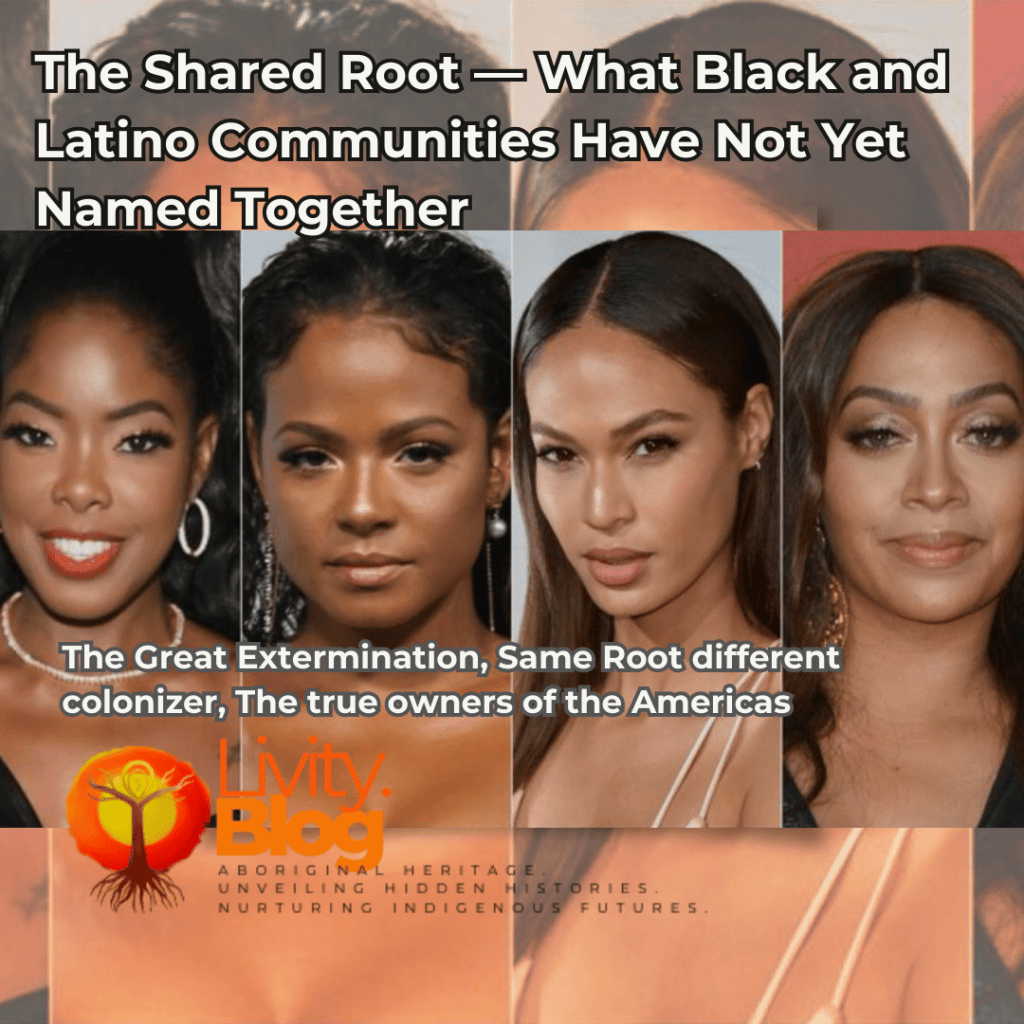
The Shared Recognition — What Black and Latino Communities Have Not Yet Named Together
The Black American community and the Latino community in the United States are typically positioned by the political and media systems as separate constituencies with separate histories and competing interests. Immigration versus citizenship. Spanish-speaking versus English-speaking. Catholic versus Baptist. The differences are real and they matter.
But the Ancestral Intelligence framework proposes that these communities share something that the political system has worked very hard to prevent them from recognizing: they are, in significant part, the absorbed descendants of the same first-line peoples, processed through different colonial systems — the British-American slave trade and one-drop rule on one side, the Spanish casta system and mestizaje ideology on the other — and now living in the same cities, often in the same neighborhoods, often in the same families through intermarriage, without the shared framework to name what they share.
The dark-complexioned Mexican man and the Black man who grew up next to each other in East Los Angeles share more than proximity. They share, in the genetic and oral tradition record that neither colonial system gave them the tools to read, a probable common ancestry in the first-line peoples of this hemisphere — peoples who held this land before any colonial system arrived, who were warriors and cosmologists and survivors of every catastrophe the ancient world produced, and who were absorbed and reclassified into different categories specifically so that their descendants would not recognize each other as kin.
The political division between these communities is not organic. It was engineered. Divide the absorbed descendants of the first-line peoples along language lines, along immigration status lines, along the specific colonial category each was placed in, and they will spend their political energy competing with each other for the scraps the system allocates to non-White communities rather than recognizing the shared land claim that both carry in their blood.
The recognition of this shared origin is not a political project. It is a truth-telling project. And the truth it would tell — that a significant portion of both the Black American and the Latino American communities are the absorbed, reclassified descendants of the oldest peoples in this hemisphere — is the truth the entire racial category system was built to prevent.
▸ Acuña, Rodolfo. Occupied America: A History of Chicanos. Harper and Row, 1972.
▸ Montejano, David. Anglos and Mexicans in the Making of Texas, 1836–1986. University of Texas Press, 1987.
▸ Haney Lopez, Ian F. White by Law: The Legal Construction of Race. NYU Press, 1996.
▸ Foley, Neil. The White Scourge: Mexicans, Blacks, and Poor Whites in Texas Cotton Culture. University of California Press, 1997.
▸ Morales, Ed. Latinx: The New Force in American Politics and Culture. Verso, 2018.
What Genetic Testing Is Beginning to Reveal
The widespread adoption of commercial genetic testing over the last decade has produced a phenomenon that the racial category system was not designed to accommodate: large numbers of African American people receiving test results that include Indigenous American ancestry that their official family history does not account for.
The standard explanation offered by testing companies and mainstream genealogists is that this reflects the documented history of African and Indigenous intermarriage and community formation in the antebellum South. This is partially true. But it does not account for the Indigenous ancestry that appears in families with no documented contact with recognized tribal communities — families whose oral traditions include inexplicable elements, whose physical features include traits that cannot be explained by their official ancestry, whose connection to specific American landscapes feels ancestral in ways they have no framework to articulate.
The Ancestral Intelligence framework offers a different explanation: some portion of the Indigenous ancestry appearing in African American genetic testing results is not the product of intermarriage between African Americans and recognized tribal members in documented historical contexts. It is the surfacing of first-line peoples’ genetics that were absorbed into the Black racial category through the specific mechanisms this article has described — and that have been carried, invisible in the official record but present in the blood, through generations of people who were told their story began on a ship.
The land claim did not expire with the reclassification. It went underground. And it is beginning to surface now — in the genetics, in the growing Afro-Indigenous movement, in the people who feel called to the specific landscapes their official history says they have no connection to, in the descendants of the first-line peoples who are starting to ask the question that the racial category system was specifically designed to prevent them from asking:
What if my people were here before the ships? What if the land I feel connected to is the land my ancestors actually held? What if the story I was given about where I come from is the story someone else needed me to believe — so they could keep what they took?
Part Six: Naming What Was Done
The Ancestral Intelligence framework does not propose that every Black American is descended from first-line Indigenous peoples. It does not claim that African ancestry is less real or less significant than Indigenous ancestry. The African root — the San lineage, the Twa forest peoples, the West and Central African peoples who were brought to the Americas through the slave trade — is itself among the oldest and most significant in the human family. The African root is sacred. The African history is real. The African suffering was not a cover story. It was the central catastrophe of the modern world.
What the framework proposes is more specific: that the racial category system in America was constructed to serve a double purpose. It justified the exploitation of African labor. And it absorbed and concealed the surviving descendants of the first-line peoples of the Americas — making their land claim invisible by placing them inside a category that, by legal definition, held no prior presence on this land.
Both things are true simultaneously. The African ancestry is real. The Indigenous ancestry is real. The people who carry both — whose ancestors were the dark-skinned, ancient-lineage peoples of this hemisphere, whether they arrived through the African diaspora, through absorption into the slave trade, or through the maroon communities and mixed-ancestry families that formed in the spaces the colonial system could not fully control — are the inheritors of both catastrophes and both lineages.
Naming what was done requires holding both truths at once: the African root is sacred. And the first-line peoples of the Americas were targeted specifically because they were warriors who would not yield, who knew the land was theirs, and who had to be not only killed but renamed before the colonial project could proceed.
The Specific Debt
If the analysis this article presents is correct — if the racial category of Black was constructed and maintained partly to conceal the absorbed descendants of the first-line peoples of the Americas and to prevent them from asserting their prior presence — then the debt owed is not only the debt of slavery. It is also the debt of the oldest land theft in American history.
The reparations conversation in the United States has always been framed around slavery: the stolen labor, the broken promise of forty acres and a mule, the century of Jim Crow economic exclusion that followed emancipation. This frame is correct as far as it goes. But if the people to whom reparations are owed include the absorbed descendants of the first-line peoples — the ones whose land claim predates not only slavery but the Beringian migrations, the ones whose ancestors were in Tennessee and Wyoming, Mexico and the Amazon before any recognized wave of recorded history — then the frame is far too narrow.
The debt is not only for the labor. It is for the land. It is for the identity. It is for the 10,000 years of oral tradition that the boarding schools cut. It is for the language that was forbidden. It is for the lineage that was reclassified. It is for every generation of people who grew up knowing something was missing from their story and had no framework to name what had been taken.
▸ Coates, Ta-Nehisi. The Case for Reparations. The Atlantic, June 2014.
▸ Dunbar-Ortiz, Roxanne. Not ‘A Nation of Immigrants’: Settler Colonialism, White Supremacy, and a History of Erasure and Exclusion. Beacon Press, 2021.
Closing: The Memory That Would Not Die
The colonial project needed three things to be permanent. It needed the land. It needed the labor. And it needed the people who were first on the land to not know that they were first — or to be unable to prove it in any court, archive, or institution that the colonial system recognized as authoritative.
It got the land. It got the labor. It did not get the third thing.
The memory did not die. It went underground, the way the first-line peoples had always survived — into the forest, into the rock, into the deepest part of the body where it could not be reached by the documents that were burned or the languages that were forbidden or the children who were taken. It went into the genetics. It went into the oral fragments that grandmothers passed to grandchildren in whispers. It went into the feeling of standing on specific ground and knowing in your blood that your people stood here before you, before anyone the history books will name.
The Ancestral Intelligence framework is the effort to give that memory its full name. To say plainly what the archive was designed to prevent from being said: that the dark-skinned peoples of the Americas — the ones who were called Black, who were enslaved, who were bounty-hunted, who were removed and reclassified and hidden inside a legal category that stripped them of their prior presence — were in many cases the oldest peoples on this land. Warriors who had never yielded. First-line peoples whose cosmology would not let them surrender the body of their ancestor. People who were not defeated but renamed.
They are still here. In the genetics that the testing companies cannot fully read. In the oral traditions that survived in fragments through families who held on. In the people who stand on American soil and feel, without being able to explain it, that this specific ground is theirs in a way that predates every legal document ever written about it.
The land remembers who walked it first. And so do the people. Even the ones who were told, for four hundred years, that their story began somewhere else.
They called them Black so you would never know they were First. But the blood knows. The land knows. And the archive — the real one, the one that lives in the bone and the oral tradition and the genetic signal that colonial science still cannot fully account for — that archive was never destroyed. It was only hidden. And it is time to read it.
Sources & Further Research
On First-Line Peoples & Genetics
▸ Skoglund, P. et al. (2015). Genetic evidence for two founding populations of the Americas. Nature, 525.
▸ Hünemeier, T. et al. (2021). Deep genetic affinity between coastal Pacific and Amazonian natives. PNAS, 118(14).
▸ Behar, D.M. et al. (2008). The Dawn of Human Matrilineal Diversity. American Journal of Human Genetics, 82(5).
On Afro-Indigenous History
▸ Forbes, Jack D. Africans and Native Americans: The Language of Race and the Evolution of Red-Black Peoples. University of Illinois Press, 1993.
▸ Katz, William Loren. Black Indians: A Hidden Heritage. Atheneum, 1986.
▸ Miles, Tiya. Ties That Bind: The Story of an Afro-Cherokee Family in Slavery and Freedom. University of California Press, 2005.
▸ Mulroy, Kevin. Freedom on the Border: The Seminole Maroons. Texas Tech University Press, 1993.
On Genocide & Extermination Campaigns
▸ Dunbar-Ortiz, Roxanne. An Indigenous Peoples’ History of the United States. Beacon Press, 2014.
▸ California Genocide: Assembly Concurrent Resolution 154, California State Legislature, 2019.
▸ Stannard, David E. American Holocaust: The Conquest of the New World. Oxford University Press, 1992.
On Racial Category as Legal Technology
▸ Alexander, Michelle. The New Jim Crow. The New Press, 2010.
▸ Harris, Cheryl I. Whiteness as Property. Harvard Law Review, 1993.
▸ Coates, Ta-Nehisi. The Case for Reparations. The Atlantic, June 2014.
▸ Cherokee Freedmen: Cherokee Nation v. Nash. Federal litigation, 1866 Treaty provisions.
On Maroon Communities
▸ Price, Richard, ed. Maroon Societies: Rebel Slave Communities in the Americas. Johns Hopkins University Press, 1979.
▸ Pena, S.D.J. et al. The genomic ancestry of individuals from different geographical regions of Brazil. PLOS ONE, 2011.
Ancestral Intelligence Series | Livity.Blog
“Rooted in Culture. Nurturing Spirits.”
© Livity.Blog. All rights reserved. Colonial Reclassification Series.

 Livity Blog